Soft tissue therapy in Smithfield, Utah
Hands-On Soft Tissue Therapy for Muscle Tension, Stiffness, Guarding, and Movement Restriction
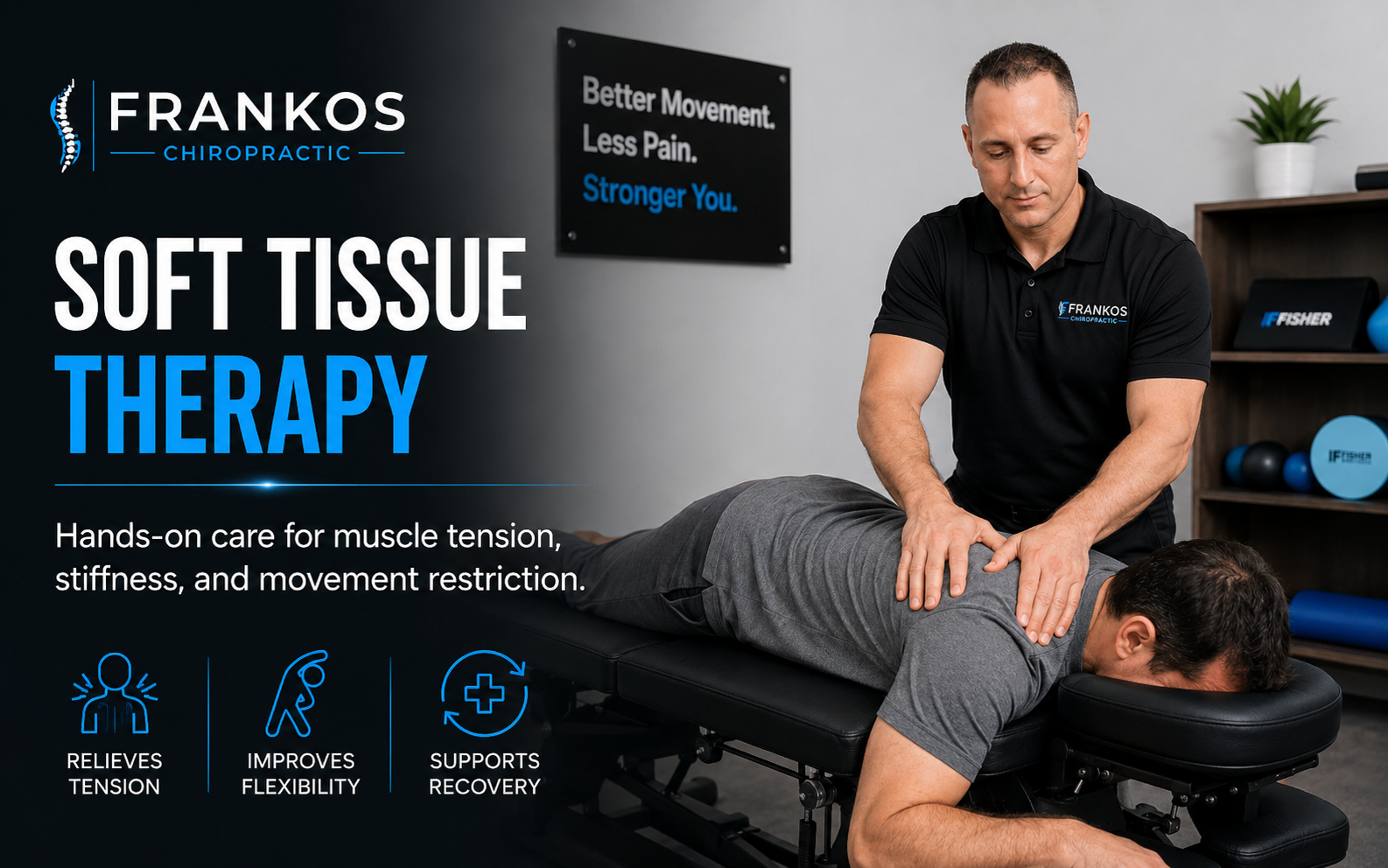
Soft tissue therapy at Frankos Chiropractic is not random rubbing and it is not a spa massage. It is exam-based, hands-on care focused on the muscles, fascia, tenderness, guarding, and movement restrictions that often contribute to neck pain, back pain, headaches, sports soreness, posture strain, and recurring tightness.
Why this page matters
Soft tissue problems are rarely just “tight muscles.”
Muscles tighten for a reason. Sometimes the reason is posture, stress, training load, joint restriction, repetitive work, poor sleep position, injury guarding, weakness, or simply doing the same movement too often. Good soft tissue care looks for the pattern instead of just chasing the sore spot.
The goal is better movement, not just temporary pressure.
Soft tissue therapy should help reduce guarding, improve comfort, prepare areas for adjustments when appropriate, and give patients a clearer plan for what keeps the tension coming back.
Soft tissue therapy may involve…
- Hands-on muscle and fascia work
- Trigger point-style pressure when appropriate
- Myofascial-style release and tissue mobilization
- Assisted stretching and mobility guidance
- Work around the neck, shoulders, mid-back, low back, hips, glutes, and legs
- Pairing with chiropractic adjustments, IASTM, cupping, traction, or shockwave when appropriate
Soft tissue care, done clinically
This is not one-size-fits-all deep pressure.
More pressure is not automatically better. A guarded low back, irritated neck, post-accident shoulder, overworked runner calf, or sensitive headache pattern may each need a different approach. The goal is useful pressure, appropriate technique, and a plan that fits the stage of the problem.
Top-tier soft tissue care starts with judgment.
Frankos Chiropractic uses soft tissue therapy as part of conservative care, not as a stand-alone claim that every pain problem is muscular. Some patients need light work. Some need more focused tissue work. Some need adjustments. Some need load management. Some need referral or urgent care first.
That is why the visit includes history, screening, movement assessment, tissue assessment, treatment tolerance, and home guidance instead of simply pushing harder on whatever hurts.
Common soft tissue patterns
What type of muscle tension or soft tissue pattern are you dealing with?
Patients often search for soft tissue therapy near Logan or Smithfield because they are tired of recurring tightness, knots, stiffness, soreness, and movement restriction that keeps coming back.
Neck, upper trap, and shoulder tension
Tight upper traps, levator scapulae, scalenes, pecs, neck stiffness, shoulder blade tension, and posture-related muscle guarding.
Low back muscle guarding
Protective tightness, spasms, stiffness, and soreness around the lumbar spine, pelvis, glutes, and hips after flare-ups or repeated loading.
Mid-back and rib tightness
Thoracic stiffness, rib-area tension, shoulder blade pain, and restricted rotation from desk work, training, driving, or postural overload.
Hip, glute, and piriformis tension
Glute tightness, hip stiffness, piriformis-region discomfort, and soft tissue restriction that can overlap with low back or sciatica-like patterns.
Sports soreness and overuse
Runners, lifters, athletes, hikers, weekend warriors, and active families may develop repeated soft tissue irritation from training load.
Headache-related muscle tension
Some headache patterns involve neck, upper trap, jaw, suboccipital, and upper back tension that should be screened and treated carefully.
Posture and desk-work tightness
Tech neck, rounded shoulders, hip flexor tightness, low back fatigue, and repeated sitting or screen-related muscle tension.
Recovery between adjustments
Soft tissue work may help prepare tight muscles and guarded areas so chiropractic adjustments and mobility work feel more comfortable.
The Frankos approach
The exam decides the soft tissue plan.
Soft tissue therapy should be specific. The visit looks at the symptoms, tissue sensitivity, movement restriction, joint mechanics, activity load, posture, red flags, and what pressure level actually helps.
History and activity load
We review work, posture, training, sleep, sports, prior injury, flare-up triggers, and what has helped or irritated the area.
Red flag and safety screen
Severe trauma, fever, infection signs, unusual swelling, bruising, clot concerns, progressive weakness, or numbness may need medical care first.
Palpation and tissue assessment
Tenderness, tone, trigger-point-like sensitivity, guarding, tissue texture, and pain referral patterns are checked based on symptoms.
Joint and movement check
Soft tissue issues often connect with joint restriction, rib motion, hip mobility, shoulder control, low back mechanics, or posture habits.
Treatment tolerance
Pressure should match the tissue, patient preference, and stage of irritation. More aggressive is not automatically better.
Home guidance and load control
You leave with practical movement, stretch, posture, activity, and recovery guidance so the same tension does not keep returning.
Visit process
What happens at a soft tissue therapy visit?
You should leave with a clearer understanding of what is tight, what is guarded, what keeps triggering it, and how soft tissue therapy fits into the rest of your care.
Listen
We review pain location, work demands, posture, exercise, injury history, sleep, stress, and symptom triggers.
Screen
We check for red flags, unusual swelling, neurological symptoms, trauma, clot concerns, infection signs, and referral needs.
Assess
We assess tissue sensitivity, tenderness, joint motion, posture, movement, and the surrounding areas feeding the problem.
Treat
Care may include hands-on soft tissue, trigger point-style work, myofascial-style release, stretching, IASTM, cupping, or adjustments.
Plan
You leave with practical guidance for movement, posture, training load, recovery, and follow-up timing.
Treatment options
Soft tissue therapy can connect with several services.
Frankos Chiropractic uses conservative options based on the exam. Soft tissue therapy may be the main tool, or it may be paired with chiropractic adjustments, IASTM, cupping, traction, shockwave, posture guidance, sports care, or home mobility.
Hands-on soft tissue therapy
Focused manual care for selected muscle tension, guarding, tenderness, and movement restriction.
Learn moreTrigger point-style work
Focused pressure and tissue work for tender, guarded, or referral-pattern areas when appropriate and tolerated.
Learn moreMyofascial-style release
Gentle to moderate tissue work aimed at improving comfort and movement through restricted muscle and fascia patterns.
Learn moreAssisted stretching and mobility
Guided mobility for hips, shoulders, upper back, neck, and low back when movement restriction is part of the pattern.
Learn moreIASTM / scraping
Instrument-assisted care may be used for selected soft tissue restriction, chronic tightness, and mobility limits.
Learn moreCupping therapy
Cupping may be discussed for selected muscle tension, recovery, and circulation-focused soft tissue care.
Learn moreChiropractic adjustments
Soft tissue therapy may be paired with adjustments when joint restriction and muscle guarding are both contributing.
Learn moreShockwave therapy
Radial shockwave may be considered for selected stubborn tendon, fascia, or chronic soft tissue problems after screening.
Learn moreActive symptoms vs maintenance
Recurring muscle tension deserves a plan, not just a quick rub.
If your tightness keeps returning, affects sleep, changes movement, causes headaches, limits training, or comes with pain into the arms or legs, book a problem-focused visit so the pattern can be evaluated.
Book soft tissue care if…
- You keep feeling tight in the same areas.
- Muscle tension affects neck, shoulders, back, hips, or glutes.
- Desk work, driving, lifting, workouts, or sports keep flaring it.
- You want soft tissue care before an adjustment.
- You need help deciding whether IASTM, cupping, shockwave, or stretching fits.
Maintenance care is different.
Wellness visits are best for appropriate patients who are not trying to evaluate new symptoms, worsening pain, neurological symptoms, or unusual soft tissue findings. If pain, swelling, weakness, numbness, or new injury is present, choose a problem-focused visit first.
Safety first
When soft tissue symptoms need medical care first.
Most muscle tension is not an emergency, but some symptoms should not be treated like routine tightness. Tell the doctor about medications, surgeries, pregnancy, cancer history, blood thinners, clot history, osteoporosis, neuropathy, or areas of reduced sensation before deeper soft tissue work.
Do not wait on these symptoms.
Seek urgent or emergency care for chest pain, shortness of breath, severe trauma, fever with severe spine pain, progressive weakness, numbness, loss of coordination, severe swelling/redness/warmth in a limb, suspected clot symptoms, unexplained bruising, infection signs, loss of bowel/bladder control, or symptoms that feel like an emergency.
Clot or swelling signs
New calf swelling, redness, warmth, severe tenderness, shortness of breath, or chest pain should be medically evaluated first.
Nerve signs
Progressive weakness, numbness, coordination changes, trouble walking, or loss of bowel/bladder control changes the plan.
Skin, trauma, or illness signs
Open wounds, infection, fever, fracture concern, severe bruising, recent surgery, or severe trauma may make soft tissue work inappropriate.
What to do at home
Soft tissue care works better when the daily trigger changes.
If the same posture, workout, lift, drive, sleep position, or work task keeps irritating the tissue, soft tissue therapy may only give short-term relief. The plan should include simple changes that actually fit your life.
Usually helpful starting points
- Use gentle movement instead of staying completely still.
- Take movement breaks before tightness becomes pain.
- Avoid repeatedly testing the sore tissue hard right after treatment.
- Hydrate and monitor normal post-treatment soreness.
- Modify the activity that keeps re-irritating the same area.
Do not chase soreness forever.
If the same knot or tight area keeps returning, the issue may involve joint restriction, posture, mobility limits, training load, weakness, nerve irritation, or a medical factor. That is why a full conservative care plan matters.
Local soft tissue care
Soft tissue therapy near Logan, Smithfield, and Cache Valley.
Frankos Chiropractic is located at 115 N Main St in Smithfield, Utah. Patients visit from Logan, North Logan, Hyde Park, Richmond, Lewiston, Providence, Hyrum, Nibley, Wellsville, Preston, Franklin, and nearby communities for soft tissue therapy and conservative chiropractic care.
Frankos Chiropractic
115 N Main St, Smithfield, UT 84335
One Smithfield office serving Cache Valley with practical, exam-based soft tissue therapy for selected muscle tension, guarding, stiffness, posture strain, sports soreness, neck tension, low back tightness, hip/glute tension, and movement restriction.
Related pages
Build the right internal pathway for soft tissue patients.
Soft tissue patients often need to understand chiropractic care, IASTM, cupping, posture, sports injuries, back pain, and neck pain before they book. These pages help them choose the right next step.
Frequently asked questions
Soft tissue therapy questions before you schedule.
These answers are educational and do not replace an exam. Your care plan depends on your history, symptoms, exam findings, goals, tissue tolerance, and whether soft tissue therapy is appropriate.
What is soft tissue therapy?
Soft tissue therapy is hands-on care focused on muscles, fascia, tendons, and surrounding tissues. At Frankos Chiropractic, it may be used for selected muscle tension, guarding, soreness, stiffness, trigger-point-like tenderness, posture strain, and movement restriction.
Is soft tissue therapy the same as massage?
It may feel similar to clinical massage in some ways, but this page is focused on chiropractic soft tissue care as part of an exam-based plan. It is not a spa massage and it is not a one-size-fits-all treatment.
What problems can soft tissue therapy help with?
It may be used for selected neck tension, upper trap tightness, low back guarding, glute and hip tension, shoulder blade pain, mid-back stiffness, sports soreness, posture-related tightness, and recovery between adjustments.
Does soft tissue therapy hurt?
It can feel tender over irritated tissue, but it should not feel unsafe or intolerable. Pressure should be adjusted to the patient, the stage of irritation, and the treatment goal.
Do you combine soft tissue with adjustments?
Yes. Many patients receive soft tissue work before or alongside chiropractic adjustments when muscle guarding and joint restriction are both contributing to symptoms.
What is the difference between soft tissue, IASTM, and cupping?
Soft tissue therapy is the broader category of hands-on muscle and fascia care. IASTM uses tools for selected tissue restriction. Cupping uses suction cups for selected tension, recovery, and circulation-focused goals.
Can soft tissue therapy help sports soreness?
It may help selected sports-related tightness, guarding, and overuse patterns, especially when paired with smart load management, mobility work, and return-to-activity guidance.
When should I avoid deep pressure?
Deep pressure may not be appropriate over open wounds, infection, acute severe swelling, suspected fracture, clot concerns, unexplained bruising, areas with reduced sensation, or certain medical conditions. Tell the doctor about medications, surgery, cancer history, pregnancy, osteoporosis, blood thinners, or vascular issues.
When should symptoms get urgent care first?
Seek urgent care for chest pain, shortness of breath, severe trauma, fever with severe spine pain, progressive weakness, numbness, loss of coordination, severe swelling/redness/warmth in a limb, or symptoms that feel like an emergency.
Where is Frankos Chiropractic located?
Frankos Chiropractic is located at 115 N Main St in Smithfield, Utah and serves Cache Valley from one Smithfield office.
Schedule at Frankos Chiropractic
Ready to find out what is driving your muscle tension and movement restriction?
Book online or call the Smithfield office. If you are a new patient, complete intake forms before your visit when possible. If you have chest pain, shortness of breath, severe trauma, progressive weakness, numbness, severe swelling/redness/warmth, fever, infection signs, or urgent symptoms, seek urgent medical care first.
Frankos Chiropractic • 115 N Main St, Smithfield, UT 84335 • One Smithfield office serving Cache Valley