Spinal decompression and traction in Smithfield, Utah
Fisher Traction and Elite Flexion-Distraction for Selected Low Back Pain, Disc-Style Irritation, and Sciatica-Like Symptoms
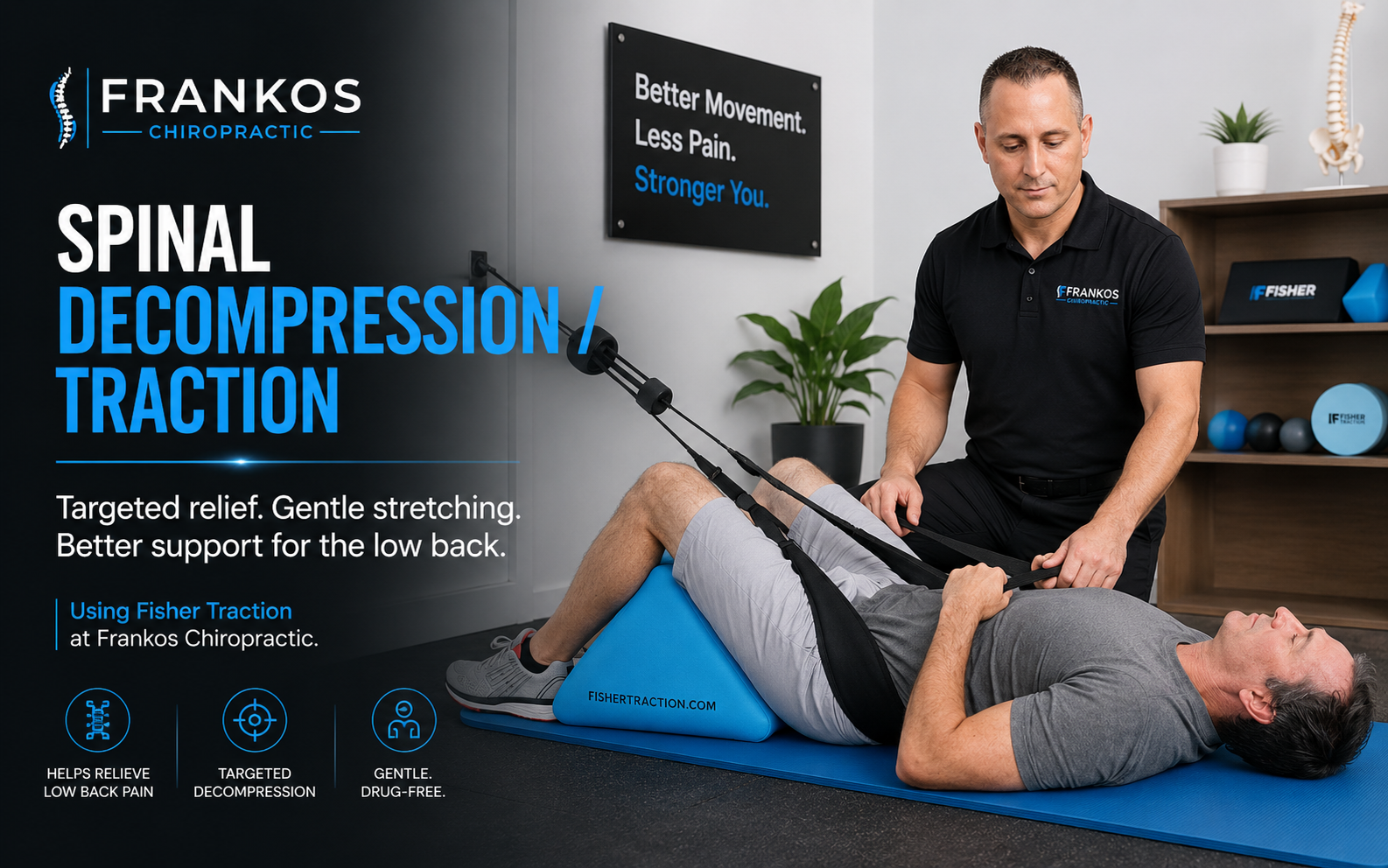
Frankos Chiropractic uses Fisher Traction and an Elite Automatic Flexion Distraction table as conservative decompression-style options for selected low back and sciatica-like patterns. The goal is not to promise a miracle or “fix a disc” in one visit. The goal is to evaluate whether gentle unloading, table-assisted flexion-distraction, or a different treatment path fits your back pain pattern, exam findings, and response to care.
Spinal decompression should be matched to the patient, not sold as a magic machine.
Back pain can come from joints, discs, muscles, nerves, hips, pelvis, posture, workload, training, or medical issues that need another provider. Traction and flexion-distraction are conservative tools. They make the most sense when the history, exam, and symptom response suggest that gentle unloading or table-assisted low back motion may help.
Book based on your back pain pattern.
Tell us whether sitting, bending, lifting, driving, coughing, standing, walking, or lying down changes your symptoms. Also tell us whether pain travels into the glute, leg, calf, or foot.
The exam decides whether Fisher Traction fits.
Traction may be discussed for…
- Selected low back pain patterns
- Disc-style irritation patterns
- Sciatica-like glute or leg symptoms
- Lumbar stiffness and guarded movement
- Pain that improves with unloading or supported positions
- Back pain aggravated by sitting, bending, lifting, or compression-like load
- Cases where Fisher Traction or flexion-distraction is part of a broader plan, not the only treatment
Fisher Traction + Elite Flexion-Distraction
Two decompression-style options. One exam-based plan.
Frankos Chiropractic uses Fisher Traction and an Elite Automatic Flexion Distraction table for selected low back and sciatica-like patterns. Fisher Traction uses a supported position and controlled strap-based lumbar traction. Flexion-distraction uses a specialized chiropractic table to apply gentle, table-assisted low back motion, flexion, and distraction when the patient’s exam and symptom behavior support that approach.
What makes decompression-style care different from guessing
The value is not the device alone. The value is deciding when it fits. Some patients need Fisher Traction. Some need flexion-distraction on the Elite table. Some need adjustments. Some need soft tissue work. Some need activity modification. Some should not receive decompression-style care until urgent symptoms or red flags are ruled out.
That is why this service page is built around a real exam, clear safety screening, and practical care planning.
What Fisher Traction is
- A conservative, non-surgical unloading-style tool.
- A supported strap-based way to apply gentle lumbar traction when appropriate.
- A possible part of a plan for selected low back and sciatica-like patterns.
- A treatment that should be adjusted based on comfort and symptom response.
- A tool that may be paired with chiropractic care, soft tissue work, and home guidance.
What decompression care is not
- Not surgical decompression.
- Not a guaranteed disc repair treatment.
- Not a replacement for urgent care when red flags are present.
- Not automatically appropriate for every back pain or leg pain case.
- Not a stand-alone fix if the same load keeps flaring symptoms.
Elite Automatic Flexion Distraction Table
Flexion-distraction gives the doctor a controlled way to work with the low back while the table moves.
Flexion-distraction is a low-force, table-assisted chiropractic technique often used for selected low back, disc-style, sciatica-like, and guarded lumbar pain patterns. Instead of forcing the low back through a painful position, the Elite Automatic Flexion Distraction table allows controlled motion and distraction while the patient stays supported.
Why the Elite table matters
- Controlled table-assisted flexion and distraction.
- Low-force setup for selected sensitive low back presentations.
- Helpful when guarded muscles limit normal motion.
- Can be paired with soft tissue work, adjustments, traction, and home guidance.
- Chosen based on exam findings, patient comfort, and symptom response.
Fisher Traction vs Flexion-Distraction
Fisher Traction is best described as supported lumbar traction and unloading.
Flexion-distraction is best described as table-assisted low back motion and decompression-style chiropractic care.
Both are conservative options. Neither is automatic for every patient. The exam decides whether Fisher Traction, Elite flexion-distraction, chiropractic adjustments, soft tissue work, mobility guidance, or referral is the best next step.
The top-tier version of decompression care is choice, not hype.
Many clinics talk about decompression as if one tool fits every disc or sciatica case. Frankos Chiropractic takes a more practical approach: identify the pain pattern, screen for warning signs, test response to movement and unloading, then choose the right combination of Fisher Traction, Elite flexion-distraction, adjustments, soft tissue therapy, and activity guidance.
Common decompression candidate patterns
What type of back pain pattern are you dealing with?
Patients often search for spinal decompression near Logan or Smithfield because they feel pressure, stiffness, disc-style irritation, or symptoms traveling into the glute or leg. These are common patterns we evaluate.
Low back pain that feels compressed
Pressure, stiffness, or aching in the low back that feels worse with sitting, bending, standing, or repeated loading.
Disc-style irritation patterns
Selected cases where symptoms behave like disc irritation, such as pain with bending, sitting, coughing, or certain loaded positions.
Sciatica-like symptoms
Glute, hamstring, calf, or foot symptoms that may be influenced by the low back, pelvis, hip mechanics, or nerve sensitivity.
Lumbar stiffness and guarded movement
Low back muscles that stay tight, protective, or locked up after flare-ups, yard work, lifting, driving, or desk work.
Relief with unloading
Some patients feel better when lying down, changing position, using support, or getting pressure off the low back.
Posture and sitting-related pain
Symptoms that build with commuting, studying, desk work, gaming, or long periods in one position.
Activity-related flare-ups
Pain that returns with lifting, shoveling, sports, ranch work, workouts, hiking, or repeated bending.
Cases that need a different first step
Severe trauma, progressive weakness, numbness, bowel/bladder symptoms, infection signs, or serious red flags need medical evaluation first.
The Frankos approach
The exam decides whether traction belongs in the plan.
Spinal decompression and traction should be specific. The visit looks at history, movement, nerve signs, red flags, low back/pelvis/hip mechanics, and whether gentle unloading improves symptoms.
History and symptom behavior
We review when pain started, what loads it, what unloads it, whether symptoms travel, and what positions make it better or worse.
Red flag and nerve screen
Progressive weakness, saddle numbness, bowel/bladder changes, severe trauma, fever, cancer history, or unexplained weight loss change the plan.
Movement and position testing
Flexion, extension, walking, sitting, hip motion, pelvis mechanics, and nerve sensitivity can help decide whether traction fits.
Low back, pelvis, and hip exam
Lumbar joints, SI joints, hips, glutes, hamstrings, and surrounding tissue can all influence low back load tolerance.
Unloading response
A key question is whether gentle unloading or traction-style positioning decreases symptoms, centralizes pain, or improves movement.
Plan and next steps
You should understand whether traction is appropriate, whether other tools are needed, and whether imaging/referral should be considered.
Visit process
What happens at a decompression or traction visit?
You should leave with a clearer understanding of what was screened, whether traction fits, what other care may be needed, and what to do between visits.
Listen
We review your pain pattern, leg symptoms, triggers, relief positions, work demands, activity goals, and prior care.
Screen
We check red flags, nerve signs, trauma history, progressive symptoms, and whether traction should be avoided or delayed.
Test
We evaluate motion, positions, low back/pelvis/hip mechanics, nerve sensitivity, and response to unloading-style positions.
Treat
Care may include Fisher Traction, flexion distraction, chiropractic adjustments, soft tissue, mobility work, or home guidance.
Plan
You leave with practical guidance on activity modification, movement, follow-up timing, and when referral or imaging may be needed.
Treatment options
Traction may work best when it is part of a broader plan.
Frankos Chiropractic uses conservative options based on the exam. Fisher Traction may be the right tool for some low back patterns, while others may need Elite flexion-distraction, adjustments, soft tissue, posture guidance, or a different referral pathway.
Fisher Traction
Frankos Chiropractic uses Fisher Traction for selected low back cases where gentle unloading and supported traction fit the exam.
Learn moreElite Flexion-Distraction Table
Low-force, table-assisted flexion and distraction for selected low back, disc-style, stiffness, or guarded movement patterns.
Learn moreChiropractic adjustments
When appropriate, care may address restricted motion in the spine, pelvis, hips, or related joints contributing to low back load.
Learn moreSoft tissue therapy
Muscle-focused care for low back guarding, glute tension, hip tightness, hamstring tension, and protective spasm patterns.
Learn morePosture and mobility guidance
Practical guidance for sitting, lifting, desk setup, hip mobility, movement breaks, and avoiding repeated symptom triggers.
Learn moreSciatica-related care
Evaluation for leg symptoms, nerve sensitivity, glute pain, and low back/pelvis patterns that may overlap with traction decisions.
Learn moreBack pain care
A broader back pain page for patients unsure whether traction, adjustments, soft tissue, or referral is the right next step.
Learn moreReferral when needed
Some presentations need urgent care, imaging, primary care, orthopedics, neurology, or co-management before traction is appropriate.
Learn moreActive symptoms vs maintenance
Disc-style back pain or sciatica-like symptoms are not a quick wellness visit.
If your symptoms involve leg pain, numbness, tingling, weakness, severe flare-ups, new injury, or pain that changes how you move, book a problem-focused visit instead of a routine maintenance adjustment.
Book traction-focused active care if…
- You have low back pain that feels worse with sitting, bending, lifting, or compression.
- You have glute, leg, calf, or foot symptoms that may be low-back related.
- You feel better with lying down, unloading, or supported positions.
- You have recurring lumbar stiffness or guarded movement.
- You want to know whether Fisher Traction fits your case.
Maintenance care is different.
Wellness or membership visits are best for appropriate patients who are not trying to evaluate new low back pain, worsening symptoms, sciatica-like symptoms, neurological concerns, or possible disc-style irritation. If traction is being considered, choose a problem-focused visit first.
Safety first
When back pain or leg symptoms need urgent medical care first.
Some symptoms should not wait for a traction appointment. Severe, progressive, neurological, trauma-related, fever-related, or bowel/bladder symptoms need the right medical pathway first.
Do not wait on these symptoms.
Seek urgent or emergency care for loss of bowel or bladder control, saddle numbness, progressive leg weakness, trouble walking, severe trauma, fever with severe spine pain, unexplained weight loss, history of cancer with new back pain, severe unrelenting pain, or symptoms that feel like an emergency.
Bowel, bladder, or saddle symptoms
Urinary retention, incontinence, loss of bowel control, or numbness around the groin/saddle area needs urgent evaluation.
Progressive nerve signs
Worsening weakness, numbness, trouble walking, foot drop, or spreading leg symptoms should be screened promptly.
Trauma or illness signs
Fall/crash injury, fever, infection concern, cancer history, severe osteoporosis risk, or unexplained weight loss changes the plan.
What to do at home
Decompression-style care works better when daily loading is managed.
The goal is not to receive traction and then immediately repeat the same load that irritated the area. Activity modification, movement breaks, lifting changes, and symptom response matter.
Usually helpful starting points
- Avoid repeatedly testing painful bending or lifting.
- Use short walks and gentle movement if they do not worsen symptoms.
- Change sitting positions often and use low back support when helpful.
- Keep loads close to the body when lifting.
- Track whether symptoms move out of the leg or further down the leg after activity.
Stop guessing if symptoms travel.
Pain that travels into the glute, thigh, calf, or foot may need a more careful nerve and low back screen. Do not assume every leg symptom is sciatica or that traction is always the right tool.
Local decompression and traction care
Spinal decompression and traction near Logan, Smithfield, and Cache Valley.
Frankos Chiropractic is located at 115 N Main St in Smithfield, Utah. Patients visit from Logan, North Logan, Hyde Park, Richmond, Lewiston, Providence, Hyrum, Nibley, Wellsville, Preston, Franklin, and nearby communities for back pain, sciatica-like symptoms, and conservative traction-style care.
Frankos Chiropractic
115 N Main St, Smithfield, UT 84335
One Smithfield office serving Cache Valley with practical, exam-based conservative care using Fisher Traction, an Elite Automatic Flexion Distraction table, chiropractic adjustments, soft tissue therapy, and movement guidance when appropriate.
Related pages
Build the right internal pathway for traction patients.
Traction patients often need to understand back pain, sciatica, chiropractic care, soft tissue therapy, posture, sports injuries, and wellness care before they book. These pages help them choose the right next step.
Frequently asked questions
Spinal decompression and traction questions before you schedule.
These answers are educational and do not replace an exam. Your care plan depends on your history, symptoms, exam findings, goals, and whether traction is appropriate.
What is spinal decompression or traction?
In this office page, spinal decompression/traction refers to conservative, non-surgical unloading-style care. Frankos Chiropractic uses Fisher Traction for selected low back cases and an Elite Automatic Flexion Distraction table for selected low-force, table-assisted decompression-style chiropractic care.
Is this surgical decompression?
No. This page is about conservative traction-style care, not surgery. Surgical decompression is a different medical procedure used in selected serious spinal compression cases by medical specialists.
What is Fisher Traction?
Fisher Traction is a low back traction device that positions the patient in a supported setup and uses controlled strap-based traction to provide gentle unloading through the lumbar region when appropriate.
What is flexion-distraction?
Flexion-distraction is a low-force chiropractic technique performed on a specialized table. The table allows controlled flexion, distraction, and motion through the low back while the patient stays supported. Frankos Chiropractic uses an Elite Automatic Flexion Distraction table for selected cases.
Who may be a good fit for traction?
Better-fit cases often include selected low back pain patterns, stiffness, disc-style irritation patterns, sciatica-like symptoms, or symptoms that improve with unloading. The exam decides whether it fits.
Who should not get traction first?
Traction may not be appropriate with severe trauma, suspected fracture, severe osteoporosis, spinal instability, infection, cancer concerns, recent surgery without clearance, progressive neurological symptoms, or urgent red flags.
Can traction help sciatica?
Some sciatica-like cases may respond to unloading, but not all leg symptoms are traction cases. The visit should screen the low back, pelvis, hips, nerve signs, and red flags before recommending traction.
Does traction hurt?
Traction should not be forced. Patients may feel stretching or pressure relief, but sharp pain, worsening leg symptoms, numbness, dizziness, or unusual symptoms should be reported immediately.
How many visits will I need?
That depends on the condition, duration, exam findings, response to care, and whether traction is being combined with chiropractic adjustments, soft tissue care, mobility work, or home guidance.
Do I need imaging before traction?
Not every patient needs imaging before conservative care, but imaging or referral may be recommended when red flags, severe trauma, progressive neurological symptoms, or failure to improve suggests it could change the plan.
Where is Frankos Chiropractic located?
Frankos Chiropractic is located at 115 N Main St in Smithfield, Utah and serves Cache Valley from one Smithfield office.
Schedule at Frankos Chiropractic
Ready to see if Fisher Traction or Elite flexion-distraction fits your back pain pattern?
Book online or call the Smithfield office. If you are a new patient, complete intake forms before your visit when possible. If you have bowel/bladder changes, saddle numbness, progressive weakness, severe trauma, fever with severe spine pain, or urgent symptoms, seek urgent medical care first.
Frankos Chiropractic • 115 N Main St, Smithfield, UT 84335 • One Smithfield office serving Cache Valley