IASTM scraping therapy in Smithfield, Utah
IASTM Scraping Therapy in Smithfield & Cache Valley
Instrument-assisted soft tissue mobilization, commonly called IASTM or scraping, uses smooth treatment tools to apply controlled pressure and movement over selected muscles, fascia, tendons, and surrounding soft tissues. At Frankos Chiropractic, it is used only when the history and exam suggest it may fit the patient’s symptoms, movement restriction, activity demands, and treatment goals.
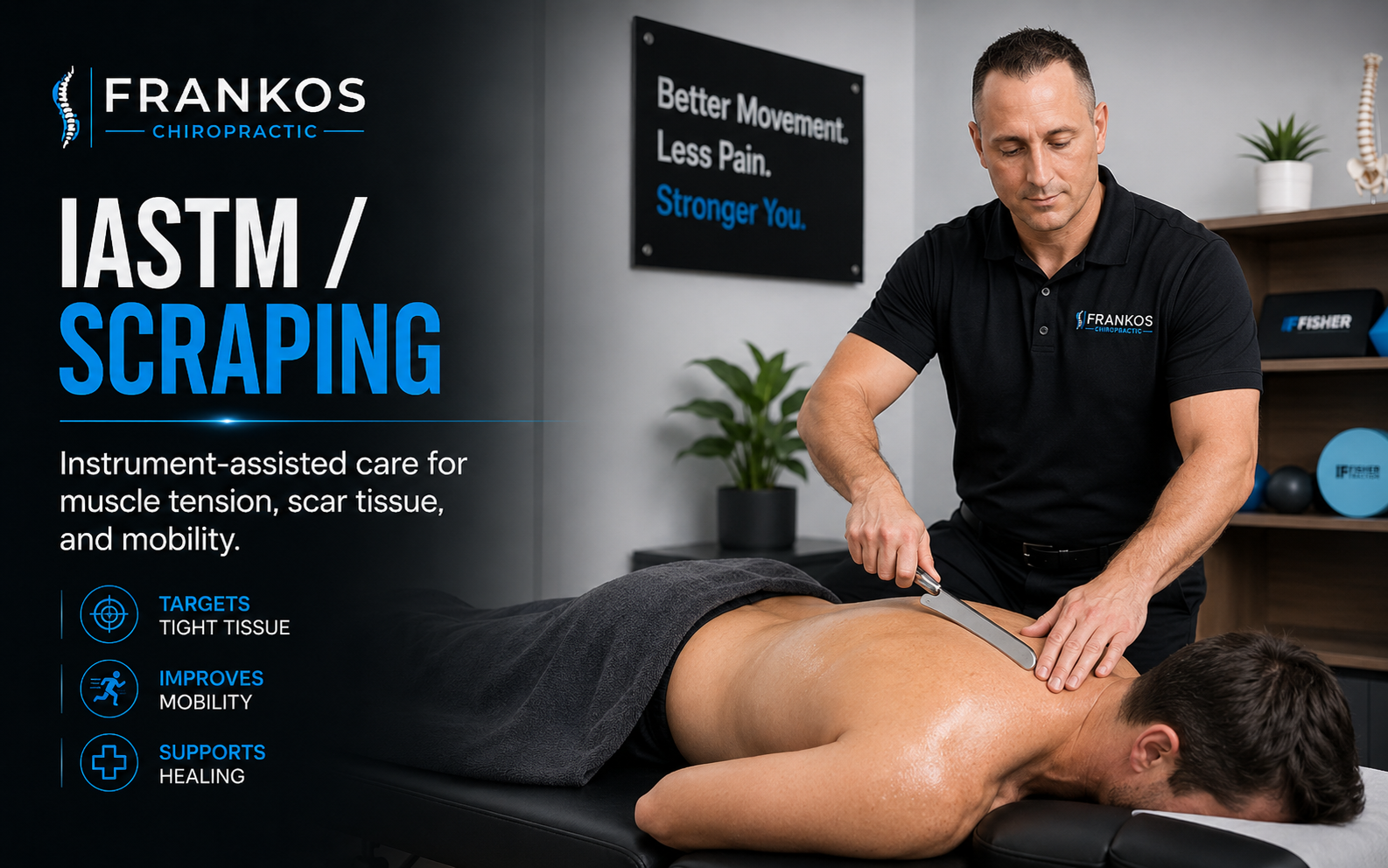
IASTM is a treatment tool—not a diagnosis and not a miracle cure.
The common word “scraping” can sound more aggressive than the treatment should be. Clinical IASTM uses a smooth instrument, controlled pressure, and repeated reassessment. The goal is not to damage the skin, force bruising, or literally scrape tissue away. The goal is to determine whether instrument-assisted contact helps a selected soft tissue or movement pattern as part of a broader plan.
The treatment should fit the finding.
Some patients respond better to hands-on soft tissue work. Others need exercise, load modification, chiropractic care, traction, shockwave therapy, medical evaluation, or no instrument work at all. The exam decides whether IASTM is reasonable.
An IASTM visit may involve…
- History, activity, medication, and skin-safety screening
- Movement and tissue assessment before treatment
- Short, controlled strokes over a selected treatment area
- Pressure adjusted to comfort, tissue irritability, and goals
- Immediate reassessment of motion, tenderness, or function
- Pairing with movement, stretching, loading, or adjustments when appropriate
A precise description
What instrument-assisted soft tissue mobilization actually means.
IASTM is a broad category of manual treatment in which a clinician uses a handheld instrument rather than only the hands. The tool can help the clinician apply contact over a wider or more specific area, feel changes in tissue response, and combine treatment with movement or exercise.
Research supports IASTM for pain relief and improved mobility in selected conditions.
Recent systematic reviews and meta-analyses report meaningful improvements in pain and range of motion after IASTM, with functional improvement also reported but less consistently. Results vary by diagnosis, treatment protocol, and whether IASTM is combined with exercise, movement guidance, chiropractic care, or other appropriate treatment.
This supports IASTM as a legitimate, exam-based treatment option—not merely an unproven add-on. Some patients experience lasting improvement, especially when treatment is paired with correction of the movement, workload, or activity factors that keep irritating the area.
The exact biological mechanisms are still being studied. IASTM may influence pain sensitivity, stretch tolerance, local tissue response, circulation, and movement. It is reasonable to use IASTM for selected scar-related stiffness and tissue restriction, but no responsible treatment should be presented as a guaranteed cure for every condition.
Common IASTM treatment regions
What type of repetitive strain, tightness, or movement restriction are you dealing with?
IASTM may be considered when a selected soft tissue region is tender, guarded, overworked, or limiting movement. These examples describe treatment regions and patterns—not guaranteed diagnoses or outcomes.
Forearm, wrist, and gripping strain
Repetitive computer work, tools, lifting, racquet sports, gripping, or hand-intensive work can create forearm and wrist soft tissue sensitivity.
Repetitive elbow tendon-area soreness
Selected tennis-elbow- or golfer’s-elbow-type patterns may involve forearm load, gripping demands, tenderness, and reduced tolerance for activity.
Upper trap, shoulder, and posture tightness
Desk work, driving, lifting, training, and repeated reaching can contribute to guarded soft tissue around the upper back and shoulder complex.
Calf, shin, and Achilles-region restriction
Running, hiking, sports, and rapid training changes may create calf tightness, shin-area soreness, or reduced ankle movement that needs evaluation.
Plantar foot and arch tightness
Selected plantar fascia and foot soft tissue patterns may be considered for instrument-assisted work as part of a broader loading and mobility plan.
Quadriceps, hamstring, and knee-region tension
Squatting, running, jumping, hiking, and lifting can create repeated tightness or sensitivity around the thigh and knee soft tissues.
Hip, glute, and lateral-thigh restriction
Hip mobility limits, running load, prolonged sitting, and training may create soft tissue patterns around the glutes, hip flexors, or lateral thigh.
Healed scar and post-procedure stiffness
Instrument work near a fully healed scar may be considered only after medical clearance, appropriate healing, and screening for sensitivity or complications.
The Frankos approach
The exam decides whether IASTM belongs in the plan.
IASTM should not be applied simply because an area feels tight. The visit considers symptom behavior, tissue irritability, skin condition, movement restriction, activity load, medications, medical history, red flags, and what changes when the area is tested.
History and activity load
We review work, sports, lifting, running, sitting, prior injuries, surgeries, flare-up triggers, and what has helped or aggravated the area.
Skin and medical screening
We screen for wounds, infection, unusual bruising, circulation concerns, reduced sensation, medications, clot history, recent surgery, and other precautions.
Movement and tissue assessment
Range of motion, tenderness, guarding, load tolerance, joint mechanics, posture, and nearby contributing regions are checked before treatment.
Tool and pressure selection
The contact angle, treatment direction, pressure, and duration should match the region, patient comfort, and stage of irritation.
Immediate reassessment
Movement, tenderness, function, or the activity that reproduced symptoms is rechecked to see whether the treatment produced a useful change.
Home movement and loading
You leave with practical guidance for movement, stretching, training load, work modification, recovery, and follow-up when appropriate.
Visit process
What happens at an IASTM scraping therapy visit?
The visit should explain why the area is being treated, how the tool fits the exam, what response is expected, and what else needs to change so the same pattern does not keep returning.
Listen
We review the symptom location, activity demands, prior care, medical history, medications, surgeries, and treatment goals.
Screen
We check the skin, circulation concerns, bruising risk, sensation, trauma, swelling, infection signs, neurological symptoms, and referral needs.
Assess
We assess tissue sensitivity, motion, strength or load tolerance, joint mechanics, and the movement that reproduces the complaint.
Treat
A smooth tool may be used with controlled pressure and short treatment passes, often followed by movement, stretching, or another appropriate service.
Recheck
We reassess the target motion or activity and provide practical guidance for recovery, loading, and follow-up.
Treatment options
IASTM often works best as one part of a broader conservative plan.
Frankos Chiropractic uses the treatment tool that best matches the exam. IASTM may be the main soft tissue technique for a selected region, or it may be combined with hands-on therapy, chiropractic adjustments, movement, cupping, shockwave, posture work, or activity guidance.
IASTM / scraping
Instrument-assisted contact for selected soft tissue sensitivity, repetitive strain, or movement restriction.
Current pageHands-on soft tissue therapy
Manual muscle and fascia work when direct hands-on treatment is a better fit than a tool.
Learn moreChiropractic adjustments
Joint-focused care may be paired with IASTM when both joint restriction and soft tissue guarding are contributing.
Learn moreMobility and posture guidance
Movement and ergonomic changes for desk work, training, repetitive tasks, and recurring restriction.
Learn moreCupping therapy
Suction-based soft tissue care may be considered for selected tension and mobility patterns.
Learn moreShockwave therapy
Radial shockwave may be considered for selected chronic tendon, fascia, and soft tissue problems after screening.
Learn moreSports and overuse care
Evaluation and return-to-activity planning for runners, lifters, golfers, hikers, students, and active adults.
Learn moreComplete services hub
Compare all conservative services available at Frankos Chiropractic.
View servicesActive symptoms vs maintenance
Recurring restriction deserves an evaluation—not aggressive scraping at random.
If the same area keeps tightening, limits motion, changes how you lift or run, creates numbness or weakness, or becomes more painful with repeated activity, choose a problem-focused visit so the pattern can be evaluated before any instrument treatment.
Book a problem-focused visit if…
- The symptoms are new, worsening, or affecting daily activity.
- You have recurring forearm, elbow, shoulder, calf, foot, hip, or thigh tightness.
- Running, lifting, tools, work, sports, or repetitive motion keep flaring the area.
- You want to know whether IASTM, soft tissue, shockwave, or exercise is the better fit.
- You have a healed scar or post-procedure restriction and already have appropriate clearance.
Maintenance care is different.
Wellness visits are intended for appropriate patients who are doing well and want routine maintenance care. New pain, worsening symptoms, unusual bruising, swelling, weakness, numbness, recent injury, or a new skin problem requires a different starting point.
Safety first
When IASTM should be modified, postponed, or avoided.
IASTM precautions are not identical for every patient or every treatment system. Tell the doctor about blood thinners, bleeding disorders, vascular disease, clot history, diabetes, neuropathy, reduced sensation, osteoporosis, cancer history, recent surgery, pregnancy, skin conditions, medications, and any area that bruises unusually easily.
Do not treat red flags like routine tightness.
Instrument treatment is generally inappropriate over open wounds, active infection, unhealed fracture, severe acute trauma, suspected blood clot, uncontrolled bleeding, active skin lesions, or an area where sensation and tissue safety cannot be judged. Urgent symptoms require medical care rather than scraping therapy.
Skin and bleeding concerns
Open wounds, active rash or infection, unexplained bruising, fragile skin, or significant bleeding risk changes or stops the treatment plan.
Clot, swelling, or vascular signs
New limb swelling, redness, warmth, severe tenderness, shortness of breath, or chest pain should be medically evaluated first.
Nerve, trauma, or illness signs
Progressive weakness, numbness, trouble walking, fever, severe trauma, suspected fracture, or loss of bowel or bladder control requires a different level of care.
What to expect afterward
Mild temporary redness or tenderness can occur. Heavy bruising is not the goal.
The skin and tissue response should be monitored during and after treatment. Some patients notice temporary warmth, redness, tenderness, or soreness. Significant bruising, sharp pain, numbness, swelling, skin damage, or symptoms that continue to worsen should be reported rather than treated as proof that the technique “worked.”
Usually helpful aftercare
- Use gentle movement through a comfortable range.
- Follow the activity and loading guidance given at the visit.
- Avoid aggressively scraping the same area yourself.
- Monitor the skin and report unusual bruising, swelling, or pain.
- Modify the activity that keeps re-irritating the tissue.
The tool cannot replace the plan.
If the same restriction keeps returning, the contributing issue may involve training load, work demands, joint mechanics, mobility, strength, nerve irritation, sleep, recovery, or a medical factor. Long-term progress usually requires more than repeated instrument passes.
Local IASTM care
IASTM scraping therapy near Logan, Smithfield, and Cache Valley.
Frankos Chiropractic is located at 115 N Main St in Smithfield, Utah. Patients visit from Logan, North Logan, Hyde Park, Richmond, Lewiston, Providence, Hyrum, Nibley, Wellsville, Preston, Franklin, and nearby communities for IASTM, soft tissue therapy, sports care, chiropractic care, and other conservative treatment options.
Frankos Chiropractic
115 N Main St, Smithfield, UT 84335
One Smithfield office serving Cache Valley with exam-based IASTM for selected repetitive strain, soft tissue sensitivity, movement restriction, sports overuse, healed scar-adjacent stiffness, and recurring tightness when appropriate.
Related pages
Build the right internal pathway for IASTM patients.
Patients considering IASTM often need to compare hands-on soft tissue care, chiropractic treatment, cupping, shockwave, posture and mobility care, sports injury care, and condition-specific pages before booking.
Frequently asked questions
IASTM scraping therapy questions before you schedule.
These answers are educational and do not replace an exam. The recommendation depends on your history, symptoms, skin condition, medications, tissue tolerance, movement findings, goals, and whether instrument-assisted care is appropriate.
What is IASTM?
IASTM stands for instrument-assisted soft tissue mobilization. A clinician uses a smooth handheld tool to apply controlled contact over selected muscles, fascia, tendons, and surrounding soft tissues as part of an exam-based treatment plan.
Is IASTM the same as scraping?
“Scraping” is a common informal name, but clinical IASTM should not mean damaging or scraping away the skin. The treatment uses controlled pressure, a smooth tool, and ongoing monitoring of comfort and tissue response.
Is IASTM the same as the Graston Technique?
Graston Technique is one branded method and training system. IASTM is the broader category of instrument-assisted soft tissue treatment and can involve different tools and clinical approaches.
Does IASTM break up scar tissue?
IASTM is commonly used for selected scar-related stiffness, adhesions, and tissue restriction, and many patients experience improved movement and comfort. The exact human mechanism is still being studied, so it is more accurate to describe the goal as improving tissue mobility, pain, range of motion, and load tolerance rather than promising that every treatment literally breaks scar tissue apart.
What problems may IASTM be considered for?
It may be considered for selected repetitive strain, sports overuse, muscle or fascial restriction, forearm or elbow tightness, calf and foot patterns, shoulder or hip restriction, and fully healed scar-adjacent stiffness after appropriate screening.
Does IASTM hurt?
The treatment can feel tender over an irritated area, but it should remain tolerable and controlled. Sharp pain, numbness, skin damage, or severe discomfort is not the goal and should be reported immediately.
Should I bruise after scraping therapy?
Mild temporary redness or tenderness can occur. Heavy bruising is not required and is not proof of a successful treatment. Pressure and duration should be adjusted to the patient’s skin, medications, medical history, and tolerance.
Do you combine IASTM with adjustments or exercise?
Yes, when appropriate. IASTM may be paired with chiropractic adjustments, hands-on soft tissue therapy, mobility work, stretching, activity modification, or progressive loading based on the exam.
How many IASTM visits will I need?
There is no universal number. The plan depends on the condition, duration, irritability, activity demands, response to treatment, and whether IASTM is producing a meaningful change compared with other options.
When should I avoid IASTM?
Instrument treatment may need to be avoided or modified with open wounds, active infection, unhealed fracture, suspected clot, severe acute trauma, significant bleeding risk, fragile skin, reduced sensation, unusual bruising, or other medical precautions.
What does the research say?
Current systematic reviews and meta-analyses support IASTM for reducing pain and improving range of motion in selected musculoskeletal conditions. Functional improvement is also reported, although results vary by condition and protocol. Evidence is strongest when IASTM is used as part of a broader plan that may include exercise, movement guidance, chiropractic care, or other appropriate treatment.
Where is Frankos Chiropractic located?
Frankos Chiropractic is located at 115 N Main St in Smithfield, Utah and serves Logan, North Logan, Hyde Park, Richmond, Lewiston, Cache Valley, and nearby Southeast Idaho communities from one Smithfield office.
Schedule at Frankos Chiropractic
Ready to find out whether IASTM fits your soft tissue or movement problem?
Book online or call the Smithfield office. If you are a new patient, complete intake forms before your visit when possible. If you have chest pain, shortness of breath, suspected clot symptoms, severe trauma, progressive weakness, numbness, severe swelling, fever, infection signs, or urgent symptoms, seek appropriate medical care first.
Frankos Chiropractic • 115 N Main St, Smithfield, UT 84335 • One Smithfield office serving Logan and Cache Valley