
Golf Injuries & Chiropractic Care in Smithfield
Golf is one of those sports that looks easy until your body reminds you it is not.
Dr Chad Frankos DC
5/29/2026
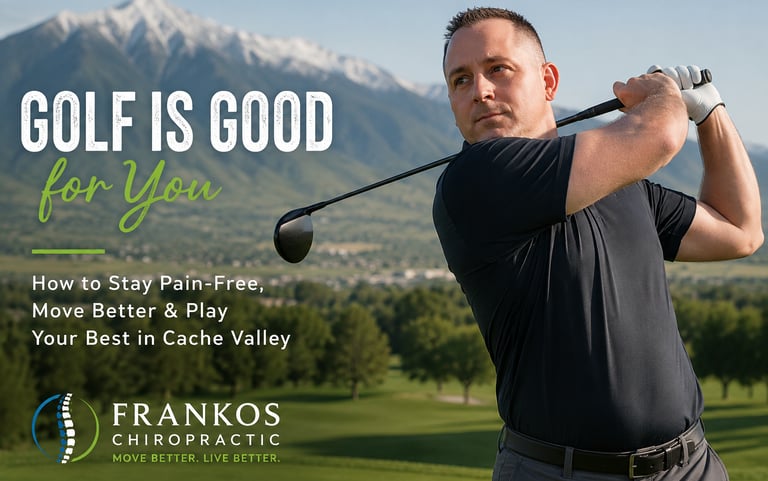

Golf Is Good for You — But Your Body Has to Be Ready for the Swing
Golf is one of those sports that looks easy until your body reminds you it is not.
You are walking, rotating, bending, loading, gripping, swinging, and repeating the same movement over and over again. For many people in Smithfield and Cache Valley, golf is one of the best ways to stay active, enjoy the outdoors, spend time with friends, and keep moving without the constant pounding of higher-impact sports.
But golf can also expose problems that have been building for years.
A stiff low back.
Tight hips.
Poor trunk rotation.
Shoulder restriction.
Elbow pain.
Neck tension.
Old injuries.
A body that sits all week and then expects to swing hard on Saturday.
Golf can be great for your health, but if your body does not move well, the golf swing can turn small restrictions into real pain.
Why Golf Can Be Good for Your Health
Golf has more health benefits than many people realize.
A round of golf can involve walking several miles, carrying or pushing a bag, climbing small hills, rotating the spine and hips, using balance, and staying active for hours. Even when using a cart, golfers are still walking, swinging, bending, and moving far more than they would while sitting at home.
Golf may help support:
General physical activity
Cardiovascular health
Balance and coordination
Mobility
Social connection
Stress relief
Mental focus
Time outdoors
Healthy aging
Consistency with movement
One of the best parts about golf is that people can often keep playing it for decades. It is competitive enough to keep people engaged, but social enough that it does not always feel like exercise.
That matters because the best exercise is usually the one you will actually keep doing.
Why Golf Can Also Cause Pain
Golf is low-impact, but it is not low-stress.
A golf swing is a fast, rotational movement. The body has to coordinate the feet, ankles, knees, hips, pelvis, low back, mid back, shoulders, arms, wrists, and neck in a very specific sequence.
When one area does not move well, another area often has to compensate.
For example:
If the hips are stiff, the low back may rotate too much.
If the mid back is tight, the neck and shoulders may overwork.
If the core is not controlling rotation well, the low back may take more stress.
If the shoulder lacks mobility, the elbow or wrist may get irritated.
If the golfer swings hard without warming up, tissues may be overloaded quickly.
This is why golfers often feel fine during the first few holes, then start noticing tightness as the round goes on.
The Most Common Golf Problems We See
Golfers can develop pain in several areas, but some regions tend to show up again and again.
Low Back Pain
Low back pain is one of the most common complaints in golfers.
This can happen because the golf swing requires rotation, side bending, extension, and force transfer through the low back and pelvis. If the hips or mid back are not moving well, the lumbar spine may take more stress than it should.
Golf-related low back pain may feel like:
A dull ache after playing
Sharp pain during the swing
Tightness after driving the ball
Pain when bending to tee up or pick up the ball
Stiffness the next morning
Pain into the glute or hip
Sciatica-like symptoms down the leg
A common pattern is the golfer who sits most of the week, then asks the body to rotate explosively during a weekend round. The body can do that for a while, but eventually the low back may start complaining.
Hip Tightness
The hips are extremely important in golf.
Good hip mobility helps the golfer rotate, load, shift weight, and follow through. When the hips are stiff, the low back often has to make up for that missing motion.
Hip restriction may contribute to:
Low back tightness
SI joint irritation
Glute pain
Limited turn in the backswing
Trouble finishing the follow-through
Compensations in the knees or feet
Golfers often think they have a “back problem” when part of the issue is actually poor hip mobility.
Neck and Shoulder Tension
Golfers also commonly deal with neck and shoulder tension.
The setup position places the head and neck in a bent-forward posture. The shoulders and upper back have to rotate and control the club. If the upper back is stiff, the neck and shoulders may overwork.
This can lead to:
Neck stiffness after a round
Shoulder tightness
Headaches
Pain between the shoulder blades
Difficulty turning the head
Upper trap tension
Irritation after driving range sessions
For some golfers, headaches start after a round because the neck and upper back have been tight for hours.
Elbow, Wrist, and Hand Pain
Golf places a lot of demand on the hands, wrists, and elbows.
Grip pressure, impact with the ground, repeated swings, and poor mechanics can all irritate the soft tissues around the elbow and forearm.
Golfers may notice:
Golfer’s elbow
Tennis elbow
Wrist soreness
Grip weakness
Forearm tightness
Pain after hitting fat shots
Pain after practice sessions
Stiffness with gripping or lifting
These problems often build gradually. A golfer may ignore mild elbow soreness for weeks, then suddenly struggle to grip the club without pain.
Knee and Foot Pain
The knees and feet matter more than many golfers realize.
The feet create the base. The knees help control rotation and weight transfer. If the hips, ankles, or feet are not moving well, the knees may absorb extra stress.
Golfers may experience:
Knee soreness after walking the course
Foot pain after 18 holes
Plantar fasciitis
Achilles tightness
Ankle stiffness
Pain when walking uneven ground
Pain when rotating through the swing
Walking a course like Birch Creek in Smithfield can be great exercise, but if your feet, hips, or low back are not tolerating the load, a good round can turn into several days of soreness.
The Problem Is Not Always the Swing
Sometimes golfers blame the swing when the bigger problem is the body.
A golf pro can help improve your technique, but if your body cannot rotate, stabilize, or move comfortably, you may struggle to make the changes your coach wants.
You may be told to turn more, stay down, rotate through, or finish your swing.
But if your hips are locked up, your mid back is stiff, your shoulders are tight, or your low back is guarding, those swing changes may feel impossible.
That does not mean chiropractic care replaces golf instruction.
It means your body has to be capable of the movement you are asking it to perform.
How Chiropractic Care May Help Golfers
At Frankos Chiropractic in Smithfield, we look at how the body is moving and where restrictions may be contributing to pain, stiffness, or compensation.
For golfers, care may focus on:
Low back mobility
Hip motion
SI joint function
Mid back rotation
Neck mobility
Shoulder mechanics
Muscle tension
Soft tissue restriction
Recovery after overuse
Movement patterns that may be feeding symptoms
Depending on the patient, treatment may include chiropractic adjustments, soft tissue therapy, spinal decompression, shockwave therapy, IASTM/scraping, cupping, and practical mobility recommendations.
The goal is not to promise a better handicap.
The goal is to help your body move better, recover better, and tolerate golf with less irritation.
What We Look for in Golfers
When a golfer comes in with pain, we want to understand what is actually contributing to the problem.
We may look at:
Where the pain is located
When it shows up during the round
Whether it is worse during the backswing, downswing, follow-through, walking, or after the round
Hip mobility
Low back motion
Mid back rotation
Neck and shoulder mobility
Muscle guarding
Prior injuries
Exercise habits
How much the patient is practicing or playing
A golfer who plays once a week may need a different approach than someone hitting hundreds of balls at the range.
A golfer with low back pain may need a different approach than someone with elbow pain.
A golfer with plantar fasciitis may need a different plan than someone with neck headaches after playing.
That is why treatment should be specific to the patient.
Simple Ways Golfers Can Protect Their Bodies
You do not need a complicated routine to start taking better care of your body before golf.
A few basics can help:
Warm Up Before You Swing Hard
Do not make your first real swing the first tee shot.
Before playing, try light movement to get the hips, back, shoulders, and neck ready.
Good options include:
Gentle trunk rotations
Hip circles
Bodyweight squats
Shoulder circles
Walking before teeing off
Slow practice swings before full-speed swings
The goal is to tell your body, “We are about to move.”
Do Not Skip Hip Mobility
Hip mobility matters because the hips help you rotate and transfer force.
Simple hip mobility work can reduce how much stress gets dumped into the low back.
Build Strength, Not Just Flexibility
Stretching can help, but golfers also need strength and control.
The body has to rotate, stabilize, and absorb force. That requires more than just being loose.
Core strength, glute strength, hip control, and shoulder stability all matter.
Respect Pain Early
Do not wait until pain is severe.
If your back, elbow, shoulder, hip, or foot starts hurting every time you play, that is your body giving you useful information.
Small problems are usually easier to address than chronic problems that have been ignored for months.
Watch the Driving Range Volume
The driving range is where a lot of golfers overdo it.
Hitting ball after ball can overload the same tissues repeatedly, especially if you are working on swing speed or making a major swing change.
Practice is good, but your body still needs recovery.
When Golf Pain Should Be Checked
You should consider getting checked if golf-related pain:
Lasts more than a few days
Keeps returning after each round
Travels into the arm or leg
Causes numbness or tingling
Affects your sleep
Changes how you walk or swing
Limits your ability to work or exercise
Gets worse instead of better
Requires frequent medication just to play
Seek urgent medical care if you experience progressive weakness, loss of bowel or bladder control, saddle anesthesia, severe unexplained pain, chest pain, shortness of breath, or symptoms that feel medically concerning.
Chiropractic Care for Golfers in Smithfield and Cache Valley
Golf should help you stay active, not leave you feeling beat up for days.
If you are dealing with back pain, neck pain, hip tightness, shoulder pain, elbow irritation, plantar fasciitis, headaches, or stiffness after golfing, Frankos Chiropractic may be able to help.
Our office is located in Smithfield, Utah, and we serve patients throughout Cache Valley and nearby Southeast Idaho, including Logan, North Logan, Hyde Park, Richmond, Lewiston, Preston, Franklin, and surrounding communities.
Whether you play most of your rounds at Birch Creek in Smithfield, Logan River in Logan, Preston Golf and Country Club, or another course around Cache Valley, the same movement demands show up again and again: rotation, walking, bending, lifting, gripping, and repeating the same swing hundreds of times.
Schedule Chiropractic Care in Smithfield
If golf is starting to hurt more than it helps, it may be time to get checked.
Frankos Chiropractic offers chiropractic adjustments, soft tissue therapy, spinal decompression, shockwave therapy, IASTM, cupping, sports injury care, wellness care, and practical movement recommendations for active patients in Smithfield and Cache Valley.
Book an appointment today and take the next step toward moving better on and off the course.