Posture Correction & Mobility Care in Smithfield & Cache Valley
Chiropractic Care for Forward Head Posture, Rounded Shoulders, Stiffness, Desk Strain, and Movement Problems
Posture is not just about standing up straight.
It is not about forcing your shoulders back all day.
It is not about trying to sit perfectly every second.
It is not about blaming every ache and pain on “bad posture.”
Posture is the way your body holds itself while you sit, stand, walk, work, drive, exercise, sleep, lift, and move through normal life.
When your body gets stuck in the same positions over and over, certain muscles may tighten, other areas may weaken, joints may lose mobility, and your neck, back, shoulders, hips, or ribs may start to feel stiff or irritated.
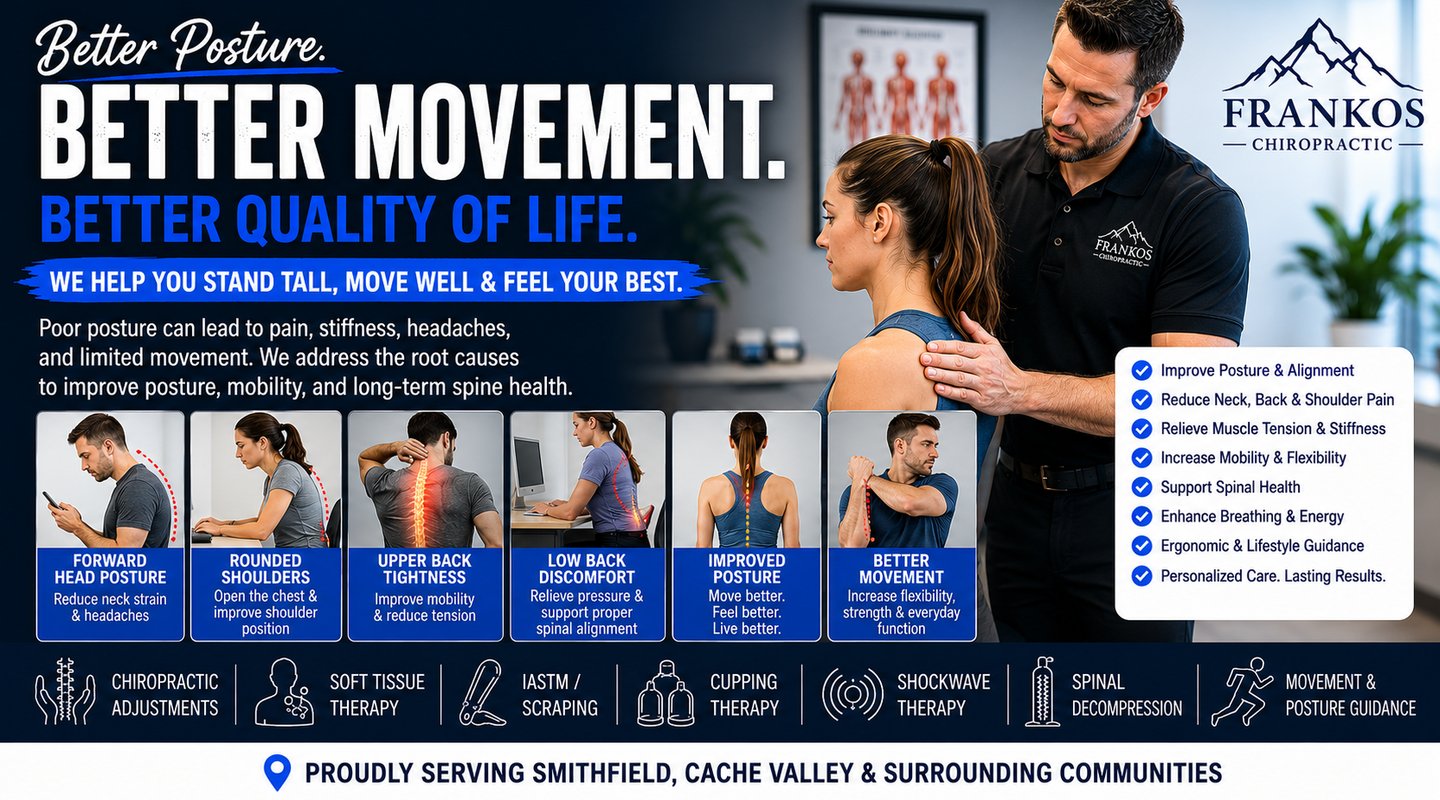
At Frankos Chiropractic in Smithfield, Utah, we help patients throughout Cache Valley with posture-related tension, forward head posture, rounded shoulders, neck stiffness, upper back tightness, low back tightness, mobility restrictions, and recurring aches that are often connected to how the body moves day after day.
The goal is not to shame your posture.
The goal is to help your body move better, tolerate daily life better, and stop feeling like you are constantly stuck, tight, or guarded.
Posture Problems Are Usually Movement Problems
A lot of people think posture is only about how they look.
But posture is more than appearance.
Posture affects how your head sits over your shoulders, how your shoulders rest on your ribs, how your spine moves, how your hips support your low back, and how your muscles share the work of holding you up.
When your body spends too much time in one position, it can adapt to that position.
For example:
Sitting all day may make the hips feel tight.
Looking down at a phone may strain the neck.
Driving for long periods may stiffen the low back.
Desk work may tighten the shoulders.
Stress may cause the neck and jaw to guard.
Lifting or physical work may create repetitive strain.
Sleeping in poor positions may leave the neck or back irritated.
Over time, those patterns can become your “normal.”
That is why posture care should not only be about reminders to sit up straight.
It should be about improving movement, reducing tension, and helping your body handle the positions you use every day.
Common Posture-Related Symptoms
Patients often visit Frankos Chiropractic because they feel like their body is always tight, stiff, or out of balance.
Common posture-related symptoms include:
forward head posture
rounded shoulders
neck stiffness
upper back tightness
tension between the shoulder blades
tight traps
headaches related to neck tension
low back tightness
hip stiffness
reduced range of motion
pain after sitting
pain after driving
stiffness after sleeping
shoulder tension
muscle knots
recurring tightness that stretching does not fix
difficulty standing tall comfortably
feeling “compressed” or hunched
fatigue from sitting or standing
poor mobility during workouts
Some people describe it as pain.
Others describe it as tightness, pressure, stiffness, or feeling like their body never fully relaxes.
Forward Head Posture
Forward head posture happens when the head sits too far forward relative to the shoulders.
This often develops gradually from habits like:
phone use
computer work
driving
studying
gaming
reading
stress posture
weak upper back endurance
tight chest and neck muscles
limited upper back mobility
Forward head posture may contribute to:
neck pain
headaches
shoulder tension
upper back tightness
jaw tension
reduced neck mobility
pain at the base of the skull
fatigue by the end of the day
The head is heavy. When it sits farther forward, the muscles in the neck and upper back often have to work harder to support it.
The answer is not to constantly force your chin back.
The better approach is to improve neck mobility, upper back motion, shoulder position, muscle control, and daily habits that keep pulling the head forward.
Rounded Shoulders
Rounded shoulders are common in people who sit, drive, lift, text, work at a computer, or carry stress in the upper body.
Rounded shoulders may be connected to:
tight chest muscles
weak upper back endurance
stiff thoracic spine
limited shoulder blade movement
forward head posture
repetitive desk work
poor lifting habits
stress-related tension
Patients may notice:
tightness across the chest
soreness between the shoulder blades
upper trap tightness
shoulder pinching
neck stiffness
difficulty standing tall comfortably
shoulder discomfort with exercise
Rounded shoulders are not always painful, but when they are paired with stiffness and tension, they can affect how the neck, shoulders, and upper back move.
Care may focus on improving upper back mobility, reducing muscle tightness, and helping the shoulders move more naturally.
Upper Back Stiffness
The upper back, also called the thoracic spine, plays a major role in posture and movement.
If the upper back is stiff, the neck and shoulders often compensate.
This can contribute to:
neck tension
shoulder pain
headaches
poor rotation
difficulty taking deep breaths comfortably
mid-back tightness
pain between the shoulder blades
rounded posture
limited overhead movement
A stiff upper back may make the shoulders work harder during lifting, reaching, or exercise.
It may also cause the neck to take on more motion than it should.
This is one reason posture care often includes the thoracic spine, ribs, shoulders, and neck together.
Neck Pain From Posture and Screen Time
Neck pain is one of the most common posture-related complaints.
People often feel it after:
working at a computer
looking down at a phone
driving
studying
gaming
reading in bed
sleeping awkwardly
carrying stress in the shoulders
Neck pain from posture may feel like:
stiffness turning the head
tightness at the base of the skull
headaches
pain into the upper traps
soreness between the shoulder blades
fatigue from holding the head up
tightness that returns quickly after stretching
The goal is not to tell you to stop using your phone or computer.
The goal is to help your neck and upper back tolerate real life better.
That may include chiropractic care, soft tissue therapy, mobility work, and simple changes to your setup or habits.
Low Back Tightness and Sitting Posture
Sitting for long periods can affect the low back and hips.
This is common for people who work at a desk, drive often, sit through school, commute, or spend long hours in one position.
Low back posture-related symptoms may include:
stiffness when standing up
tight hips
low back pressure
pain after sitting
pain driving
tightness in the glutes
difficulty bending after being seated
recurring low back flare-ups
Sitting is not automatically bad.
The problem is usually staying in one position too long and not giving the body enough variation.
Low back posture care may involve the spine, hips, pelvis, glutes, hip flexors, hamstrings, and core control.
Posture and Headaches
Some headaches may be connected to neck and upper back tension.
Posture-related headache patterns may include:
tension at the base of the skull
headaches after screen time
headaches after driving
tight shoulders with headaches
pressure around the temples
headaches that worsen with stress posture
neck stiffness before or during headaches
Not every headache comes from posture, and not every headache belongs in a chiropractic office first.
But when headaches consistently appear with neck stiffness, shoulder tension, or reduced range of motion, the neck and upper back should be evaluated.
Posture and Shoulder Pain
The shoulder does not work alone.
It depends on the neck, upper back, ribs, shoulder blade, and surrounding muscles.
If posture and mobility are affecting shoulder mechanics, patients may feel:
pinching with overhead movement
tight shoulders
shoulder blade tension
rotator cuff irritation
upper trap tightness
pain during workouts
discomfort reaching overhead
limited range of motion
When the upper back is stiff or the shoulder blade does not move well, the shoulder joint may have to work harder.
That can contribute to irritation over time.
Posture care for shoulder problems often includes the upper back, ribs, neck, chest, shoulder blade, and rotator cuff muscles.
Posture and Breathing
Posture can affect how the ribs, upper back, and diaphragm move.
When the upper body feels rounded, tight, or compressed, some patients feel like they cannot take a full comfortable breath.
This does not mean every breathing concern is posture-related.
Shortness of breath, chest pain, dizziness, or breathing symptoms that feel unusual should be evaluated medically.
But for some patients, upper back and rib stiffness can contribute to the sensation of restricted movement through the chest and shoulders.
Improving upper back mobility and reducing tension may help the body feel less compressed.
Posture and Stress
Stress often shows up physically.
Many people hold stress in the neck, jaw, shoulders, upper back, and low back.
That can create:
tight traps
jaw clenching
headaches
neck stiffness
shoulder tension
shallow breathing
muscle knots
difficulty relaxing
Chiropractic care does not remove stress from life.
But it may help address the physical tension patterns that build up from stress, posture, and repeated daily strain.
Posture in Students and Teens
Posture issues are not only an adult problem.
Students and teens often spend long hours sitting in class, studying, using laptops, looking down at phones, gaming, wearing backpacks, and participating in sports.
Common posture-related complaints in students may include:
neck pain
headaches
upper back tightness
rounded shoulders
low back stiffness
shoulder tension
discomfort after sitting in class
pain after studying or gaming
stiffness from backpacks
sports-related movement restrictions
Kids and teens are still growing, so persistent pain should be taken seriously.
The goal is not to scare them about posture.
The goal is to help them build better movement habits early and address pain that keeps returning.
Posture in Active Adults
Active adults may still struggle with posture and mobility.
Being active does not automatically mean every joint moves well.
Lifters, runners, hunters, hikers, skiers, golfers, pickleball players, rodeo athletes, weekend warriors, and physically active workers may all deal with posture-related tightness.
Common patterns include:
tight hips from sitting and lifting
rounded shoulders from pressing or desk work
stiff upper back affecting overhead movement
low back tightness after workouts
neck tension from stress and driving
shoulder pain with lifting
recurring flare-ups from old injuries
For active adults, posture care should not be about perfect posture.
It should be about mobility, control, recovery, and helping the body tolerate the activities you actually want to do.
Posture in Parents
Parents often develop posture-related pain from daily life.
Common triggers include:
carrying babies
nursing or bottle feeding posture
lifting toddlers
bending into cribs
carrying car seats
cleaning
laundry
lack of sleep
stress
holding children on one hip
This can create neck pain, shoulder tension, mid-back stiffness, low back tightness, and hip discomfort.
Posture care for parents needs to be realistic.
You cannot stop being a parent.
The goal is to make daily movements easier on your body and reduce the tension patterns that keep building up.
Posture in Physical Workers
Many Cache Valley patients work hard physically.
Farm work, construction, mechanics, healthcare, cleaning, landscaping, trade work, warehouse work, lifting, bending, and long standing days can all create posture and mobility problems.
These patients may not be sitting at a desk all day, but they can still develop:
low back tightness
neck stiffness
shoulder tension
hip stiffness
one-sided pain
repetitive strain
muscle guarding
reduced mobility
recurring flare-ups
For physical workers, posture care is often about work mechanics, recovery, mobility, and reducing repetitive strain.
The goal is not to tell you to avoid hard work forever.
The goal is to help your body handle it better.
Posture Is Not About Perfection
One of the biggest myths is that there is one perfect posture you should hold all day.
That is not realistic.
Even a “good” posture can become uncomfortable if you stay in it too long.
Your body likes variety.
That means posture care should include:
better movement
more position changes
improved mobility
stronger postural endurance
less stiffness
better work setup
better recovery habits
reducing repeated strain
A healthy posture is not frozen.
A healthy posture is adaptable.
Why Stretching Alone Does Not Always Fix Posture
Many patients try stretching first.
Stretching can help.
But if the same tightness keeps coming back, stretching may not be enough.
That may happen because:
joints are restricted
muscles are guarding
posture habits keep re-irritating the area
weakness or poor endurance is contributing
the upper back is stiff
hips are not moving well
stress keeps tightening the same muscles
work setup is feeding the problem
sleep position is irritating the neck or back
Posture problems often need a combination of mobility, soft tissue work, joint movement, strengthening, and habit changes.
That is why the goal is not just to “stretch tight muscles.”
The goal is to understand why they keep getting tight.
When Posture-Related Pain Should Be Checked
Most posture-related pain is not an emergency, but some symptoms should not be ignored.
Seek medical evaluation if pain is associated with:
chest pain
shortness of breath
sudden severe headache
dizziness or fainting
unexplained weakness
numbness or tingling that is worsening
loss of bowel or bladder control
fever or unexplained illness
severe pain after trauma
pain that wakes you at night and does not change with position
unexplained weight loss
symptoms spreading into the arms or legs
worsening balance or coordination problems
Chiropractic care can help many musculoskeletal posture and mobility problems, but not every symptom belongs in a chiropractic office first.
If your symptoms suggest something that needs medical evaluation, imaging, or referral, we will tell you.
How Chiropractic Care May Help Posture and Mobility
Chiropractic care for posture and mobility focuses on improving how the spine, joints, muscles, and movement patterns work together.
Care may help by:
improving joint motion
reducing stiffness
decreasing muscle guarding
improving neck mobility
improving upper back mobility
improving hip and pelvic motion
addressing soft tissue tension
helping the shoulders move better
reducing strain from repeated positions
improving movement confidence
The goal is not to force your body into one perfect position.
The goal is to help your body move with less restriction and hold itself more comfortably during daily life.
Our Posture and Mobility Treatment Approach
At Frankos Chiropractic, posture and mobility care may include several treatment options depending on the patient.
Chiropractic Adjustments
Adjustments may be used to improve motion in restricted areas of the spine, ribs, pelvis, hips, shoulders, or other joints.
When joints are not moving well, surrounding muscles often tighten and guard.
Improving joint motion may help the body move more naturally.
Soft Tissue Therapy
Soft tissue therapy may help with tight muscles, trigger points, muscle guarding, and areas that feel stuck or overworked.
This may include work through the neck, shoulders, upper back, low back, hips, glutes, or surrounding areas.
IASTM / Scraping
IASTM may be used when soft tissue restrictions feel chronic or difficult to change with basic stretching.
It may be helpful for certain posture-related tension patterns in the neck, upper back, shoulders, hips, or lower body.
Cupping Therapy
Cupping may be used for muscle tension, soft tissue restriction, and stiffness.
It is often combined with other care when appropriate.
Spinal Decompression
Spinal decompression may be considered for certain patients with low back pain, disc-related irritation, or nerve-related symptoms.
It is not needed for every posture-related complaint.
Mobility Recommendations
Posture care often works better when office treatment is paired with simple home movement.
Depending on your symptoms, we may discuss:
neck mobility
upper back mobility
hip mobility
shoulder blade movement
gentle stretching
strengthening basics
movement breaks
desk setup
sleeping position
lifting habits
driving posture
The best plan is one you can actually use.
Desk Posture and Ergonomics
A lot of posture-related pain comes from work setup.
Common desk issues include:
monitor too low
laptop use without a separate keyboard
chair too high or too low
feet unsupported
shoulders shrugged
wrists reaching too far
sitting too far from the desk
leaning forward
no lumbar support
staying in one position too long
Helpful desk habits may include:
keeping the screen near eye level
keeping feet supported
keeping shoulders relaxed
keeping elbows close to the body
using a chair that supports the low back
taking short movement breaks
keeping frequently used items close
avoiding long periods of reaching
changing positions throughout the day
Your workspace does not have to be perfect.
But small adjustments can reduce how much stress your neck, shoulders, and low back take every day.
Phone Posture and “Tech Neck”
Looking down at a phone for long periods can strain the neck and upper back.
This is often called “tech neck.”
Symptoms may include:
neck stiffness
upper trap tightness
headaches
shoulder tension
soreness between the shoulder blades
reduced range of motion
fatigue by the end of the day
You do not have to stop using your phone.
But you can change how often your body gets stuck in that position.
Try:
bringing the phone closer to eye level
changing positions often
taking breaks from looking down
relaxing the shoulders
doing gentle neck movement
avoiding long scrolling sessions in bed
Small habits add up.
Sleep Posture
Sleep position can affect neck, shoulder, and low back stiffness.
Some patients wake up with:
neck pain
headaches
shoulder stiffness
low back tightness
hip discomfort
numbness or tingling
pain from sleeping twisted
Helpful sleep changes may include:
using a pillow that supports the neck without forcing it up
avoiding stomach sleeping if it twists the neck
using a pillow between the knees when side sleeping
using a pillow under the knees when sleeping on the back
avoiding sleeping with the arm trapped overhead
changing positions slowly if you wake up stiff
Sleep does not explain every posture problem, but poor sleep positioning can keep irritation going.
Driving Posture
Driving can make posture-related pain worse, especially in Cache Valley where many people commute between Smithfield, Logan, North Logan, Hyde Park, Richmond, Preston, and other nearby communities.
Driving may aggravate:
neck pain
low back tightness
hip stiffness
shoulder tension
headaches
sciatica-like symptoms
Helpful changes may include:
sitting close enough to avoid reaching
keeping shoulders relaxed
using low back support
adjusting mirrors so you are not craning forward
taking breaks during long drives
avoiding sitting on a wallet
changing position before stiffness builds
If driving always triggers pain, the issue may be more than the seat.
It may involve mobility, joint restriction, muscle guarding, or nerve irritation that needs evaluation.
Mobility Matters More Than Perfect Posture
Mobility is the ability to move through a comfortable range.
When mobility is limited, the body compensates.
For example:
If the upper back is stiff, the neck may work too hard.
If the hips are tight, the low back may take extra stress.
If the shoulders are restricted, the upper traps may overwork.
If the ankles are stiff, the knees, hips, and back may compensate.
This is why posture correction should include mobility care.
A body that moves well usually feels better than a body trying to hold a perfect posture all day.
Strength and Postural Endurance
Posture is not only about flexibility.
It also requires endurance.
Your body needs muscles that can support you during the positions you use every day.
Depending on the patient, posture care may eventually involve strengthening areas like:
deep neck flexors
upper back muscles
shoulder blade stabilizers
core muscles
glutes
hips
spinal stabilizers
This does not have to be complicated.
Even simple consistency can make a difference when the right areas are targeted.
What You Can Do at Home
For posture-related stiffness, start with simple changes:
move more often
avoid staying in one position too long
take short walking breaks
bring screens closer to eye level
relax your shoulders
avoid aggressive stretching into pain
support your low back when sitting
use a pillow that supports your neck
stretch gently instead of forcing it
add light mobility throughout the day
check your desk setup
change positions before pain builds
The most important habit is movement variety.
Your next posture is often your best posture.
What Your First Visit Looks Like
Your first visit is focused on understanding your pain, posture habits, and movement restrictions.
We will talk through:
where you feel tightness or pain
when symptoms started
what positions make it worse
what movements feel limited
work and desk habits
phone and driving habits
sleep position
exercise habits
past injuries
whether symptoms travel into arms or legs
what you have already tried
your goals for care
From there, we decide what type of care makes sense.
Some patients need chiropractic adjustments and soft tissue therapy.
Some need upper back and neck mobility work.
Some need hip and low back support.
Some need ergonomic changes.
Some need simple movement recommendations.
Some need referral if symptoms suggest something outside chiropractic care.
The goal is to match care to the person, not force every posture complaint into the same plan.
Posture and Mobility Care for Cache Valley Patients
Frankos Chiropractic is located in Smithfield, Utah and serves patients throughout Cache Valley and nearby Southeast Idaho.
Patients commonly visit us from:
Smithfield
Logan
North Logan
Hyde Park
Richmond
Lewiston
Providence
Hyrum
Wellsville
Nibley
Preston, Idaho
Franklin, Idaho
surrounding Cache Valley and Southeast Idaho communities
Our office is physically located in Smithfield, and patients from nearby communities often travel to us for posture correction, mobility care, chiropractic adjustments, soft tissue therapy, IASTM, cupping, decompression, and movement-focused treatment.
Why Patients Choose Frankos Chiropractic for Posture and Mobility
Patients choose our office because they want practical care and clear explanations.
We try to keep the process simple:
Listen to what feels tight or painful.
Look at how your body moves.
Treat what is actually contributing.
Help you understand what to do next.
Patients often appreciate:
personalized posture and mobility care
chiropractic adjustments
soft tissue therapy
IASTM / scraping
cupping therapy
spinal decompression when appropriate
practical home recommendations
same-day appointments when available
walk-ins when the schedule allows
a smaller Smithfield clinic environment
We are not here to tell you your posture is terrible.
We are here to help your body move and function better.
Frequently Asked Questions About Posture and Mobility
Can chiropractic care help posture?
Chiropractic care may help when posture problems are connected to joint restriction, muscle tightness, stiffness, movement limitations, or compensation patterns. Posture care often works best when combined with mobility work and daily habit changes.
What causes forward head posture?
Forward head posture may develop from screen use, phone posture, driving, studying, stress, weak postural endurance, upper back stiffness, or repeated daily positions.
Can posture cause neck pain?
Posture can contribute to neck pain, especially when the head and shoulders stay forward for long periods. Neck pain may also involve joints, muscles, discs, nerves, stress, sleep position, or prior injuries.
Can posture cause headaches?
Some headaches may be related to neck tension, upper back stiffness, or muscle tightness. Not every headache comes from posture, so evaluation matters.
Why do my shoulders feel rounded and tight?
Rounded shoulders may be related to tight chest muscles, weak upper back endurance, stiff upper back movement, desk work, phone use, stress, or repeated daily posture habits.
Is sitting bad for posture?
Sitting is not automatically bad. The bigger issue is sitting too long without moving, poor support, or positions that repeatedly strain the neck, shoulders, hips, or low back.
What is the best posture?
The best posture is usually the one you do not stay in forever. The body likes movement and variation. A healthy posture is adaptable, not stiff or forced.
Do posture braces fix posture?
Posture braces may provide temporary feedback, but they usually do not solve the underlying movement, strength, or habit patterns. Long-term improvement usually requires mobility, strength, and behavior changes.
Can kids and teens benefit from posture care?
Yes. Students and teens may develop neck pain, headaches, upper back tension, rounded shoulders, or low back stiffness from school, phones, gaming, backpacks, and sports. Persistent pain in children should be evaluated carefully.
Do you accept walk-ins?
Walk-ins are welcome when the schedule allows. Booking ahead is recommended to make sure we have time available.
Schedule Posture and Mobility Care in Smithfield
If posture-related neck pain, upper back tension, headaches, rounded shoulders, low back tightness, or mobility problems are making daily life harder than it should be, Frankos Chiropractic is here to help.
Our Smithfield office provides chiropractic care, soft tissue therapy, IASTM, cupping therapy, spinal decompression when appropriate, and movement-focused care for posture and mobility problems throughout Cache Valley.
Book an appointment today and take the next step toward moving better, feeling less restricted, and understanding what your body needs.