Sports Injury Chiropractor in Smithfield & Cache Valley
Chiropractic Care for Adult Athletes, Youth Athletes, Active Families, and Weekend Injuries
Sports injuries do not only happen to competitive athletes.
They happen to adults who lift, run, ski, hike, bike, hunt, play rec league sports, work out, or push hard on weekends after a long workweek.
They also happen to kids and teens who are in football, soccer, basketball, baseball, softball, volleyball, wrestling, gymnastics, dance, cheer, track, rodeo, cross-country, mountain biking, skiing, and other activities.
Sometimes the injury is obvious.
A twist.
A fall.
A collision.
A hard landing.
A pulled muscle.
A shoulder that starts hurting after throwing.
A knee, foot, or back that keeps flaring up during practice.
Other times it builds slowly until an athlete realizes they can no longer move, train, compete, or recover the way they used to.
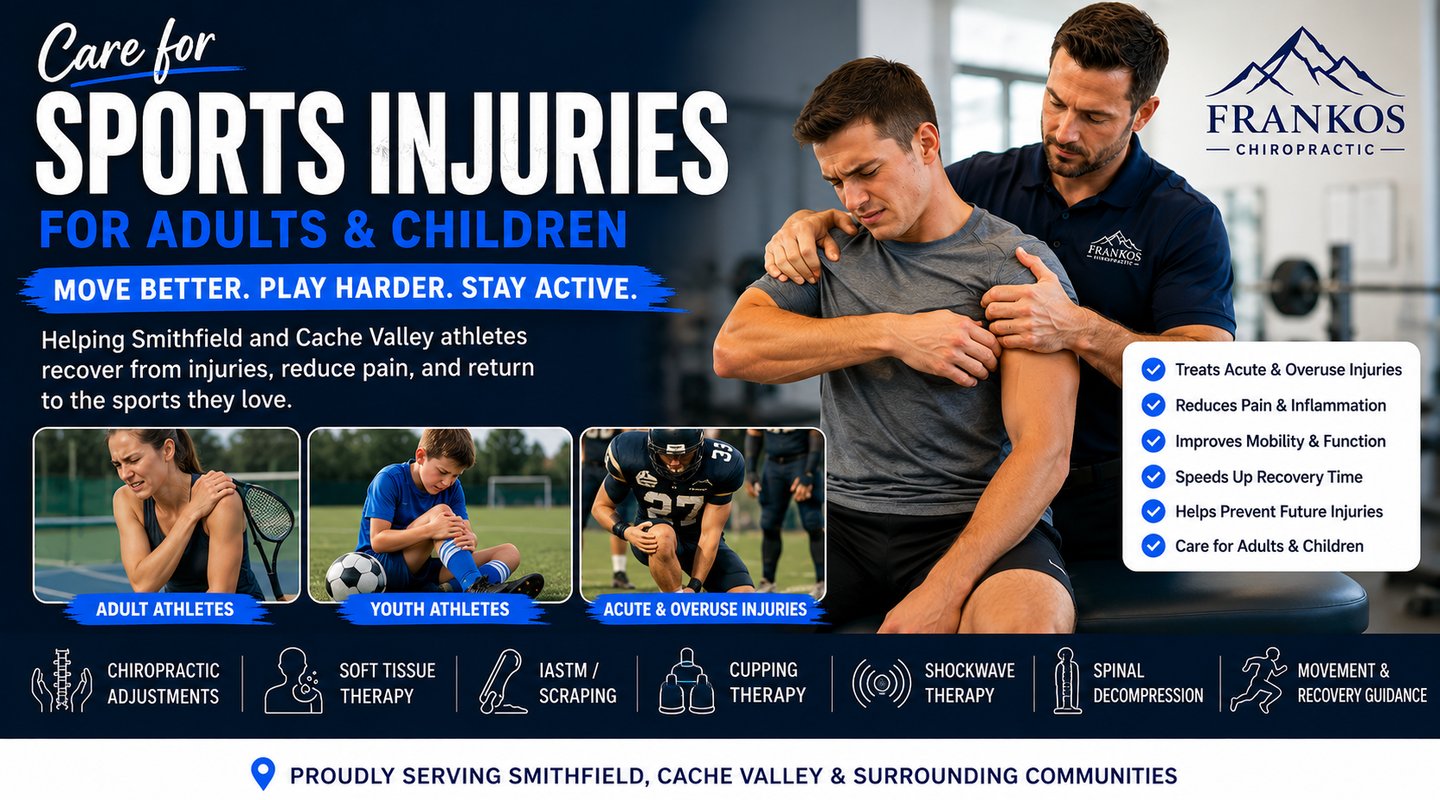
At Frankos Chiropractic in Smithfield, Utah, we help adults and children throughout Cache Valley with sports-related pain, stiffness, mobility problems, overuse injuries, soft tissue irritation, and movement restrictions.
Our goal is not to just get someone back on the field as fast as possible.
The goal is to understand what is injured, what movement patterns are contributing, what needs to calm down, and what type of care makes sense for that athlete’s age, sport, and goals.
Sports Injuries Are Not All the Same
A sports injury can involve muscles, tendons, ligaments, joints, bones, nerves, or movement patterns.
Some injuries are acute. That means they happen suddenly, often from a fall, hit, twist, sprint, lift, or awkward landing.
Other injuries are overuse injuries. These happen from repeated stress over time. The athlete may not remember one specific moment when the pain started.
Both types matter.
An adult with shoulder pain from lifting needs a different approach than a 12-year-old with knee pain during soccer. A high school pitcher with elbow pain needs a different conversation than a weekend runner with plantar fasciitis. A youth gymnast with back pain needs different caution than an adult with general muscle tightness.
That is why the first step is figuring out what kind of sports injury we are dealing with.
Common Sports Injuries We See
Patients often visit Frankos Chiropractic for sports-related problems such as:
low back pain
neck pain
shoulder pain
rotator cuff irritation
hip tightness
knee pain
ankle sprains
plantar fasciitis
Achilles irritation
shin splints
elbow pain
tennis elbow
golfer’s elbow
wrist pain
muscle strains
ligament sprains
mobility restrictions
overuse injuries
recurring tightness
pain after workouts
pain that returns during practice or games
Some injuries are mild and improve with rest and smart activity changes.
Others need a more careful evaluation, especially when there is swelling, weakness, inability to bear weight, numbness, deformity, or pain directly over bone.
Adult Sports Injuries
Adult athletes often have a different set of problems than kids.
Adults may be balancing work, family, stress, sleep, old injuries, and training. Many are not injured because they are out of shape. They are injured because life is busy, recovery is limited, and the body is being asked to do a lot.
Common adult sports injury patterns include:
low back pain after lifting
neck and shoulder tension from workouts
knee pain during running or squats
hip tightness from lifting or hiking
plantar fasciitis from running or standing
Achilles irritation
shoulder pain from pressing or throwing
elbow pain from gripping, golf, pickleball, or lifting
muscle strains after returning to activity too quickly
recurring flare-ups from old injuries
Adult patients often say:
“I can still do it, but I pay for it later.”
“I feel fine warming up, but then it comes back.”
“My back tightens after workouts.”
“My shoulder hurts when I press.”
“I do not want to stop training, but something is not right.”
“I just want to stay active without constantly hurting.”
The goal with adults is usually not to shut everything down.
The goal is to reduce irritation, improve movement, and modify activity enough for the body to recover while still keeping the person moving when appropriate.
Youth Sports Injuries
Kids and teens are not just smaller adults.
They are growing.
That means their bones, muscles, tendons, and growth plates are still developing. During growth spurts, muscles and tendons may feel tighter, coordination may change, and certain areas can become more sensitive to repetitive stress.
Youth athletes may not always explain symptoms clearly. Some will keep playing because they do not want to lose a starting spot, disappoint a coach, miss a tournament, or sit out with friends.
Parents may notice:
limping
favoring one side
reduced speed
changes in throwing, running, jumping, or landing
loss of interest in practice
pain that increases with activity
swelling
avoiding certain movements
complaining after games but not during them
pain that keeps returning despite rest
AAOS lists warning signs in young athletes such as pain that increases with activity, swelling, changes in form or technique, and decreased interest in practice. In growing athletes, pain from repetitive stress may even show up away from the actual injury site, such as knee pain that may be related to the hip.
Overuse Injuries in Children and Teens
Overuse injuries are common in youth sports.
They often happen when the same tissues are loaded repeatedly without enough recovery time.
This may happen with:
year-round sports
early specialization
tournament-heavy schedules
multiple teams at once
too many practices or games
growth spurts
poor sleep
inadequate recovery
repetitive throwing, jumping, running, kicking, or tumbling
playing through pain
Common youth overuse patterns include:
heel pain
knee pain
shin pain
shoulder pain
elbow pain
low back pain
hip pain
ankle pain
tendon irritation
growth-plate-related pain
This does not mean kids should avoid sports.
Sports can be great for strength, confidence, coordination, social connection, and discipline.
But pain that keeps getting worse with activity is not something to ignore.
Growth Plate Concerns in Young Athletes
Growth plates are areas of developing tissue near the ends of children’s bones.
Because growth plates are not fully matured yet, they can be more vulnerable to injury than adult bone or tendon structures.
This matters in sports.
A child with persistent pain near a joint, especially with swelling, tenderness, limping, or loss of motion, may need medical evaluation to rule out a growth plate injury or other problem.
In our office, we are careful with young athletes.
If symptoms suggest something that needs imaging, pediatric evaluation, orthopedic care, or a medical referral, we will tell you.
Chiropractic care can help many movement-related and soft tissue problems, but not every youth sports injury belongs in a chiropractic office first.
Acute Sports Injuries
An acute injury happens suddenly.
Examples include:
ankle sprain
muscle strain
fall
collision
twisted knee
shoulder injury
hard landing
sudden back pain during lifting
neck pain after impact
wrist or elbow injury
hip or groin pull
Initial care often depends on severity.
For many soft tissue injuries, the RICE method — rest, ice, compression, and elevation — is commonly used early to help reduce pain and swelling. Cleveland Clinic notes that RICE can help with acute inflammation, swelling, pain, and bleeding in soft tissues, especially in the early phase.
But RICE is not the whole recovery plan.
Once the acute phase settles, the athlete often needs to restore motion, strength, control, and confidence before fully returning to sport.
Sprains vs. Strains
People often use these words interchangeably, but they are different.
A sprain involves a ligament.
Ligaments connect bone to bone and help stabilize joints. An ankle sprain is a common example.
A strain involves a muscle or tendon.
Muscles and tendons help create movement. A pulled hamstring, calf strain, or low back muscle strain are common examples.
Both can range from mild to severe.
Mild injuries may improve with basic care and gradual return to activity. More serious injuries may involve tearing, instability, significant swelling, bruising, or inability to use the area normally.
When a Sports Injury Needs Medical Attention
Some sports injuries should be evaluated quickly.
Seek medical care if there is:
inability to bear weight
inability to use the injured joint
severe pain
sudden swelling
obvious deformity
pain directly over bone
numbness
joint instability
major loss of motion
repeated injury to the same area
head injury or suspected concussion
worsening pain despite rest
symptoms that continue to spread
fever, redness, or signs of infection
Mayo Clinic notes that sprains should be checked when a person cannot move or bear weight on the joint, has pain directly over bone, or has numbness in the injured area.
For children, I would be even more cautious.
If a child has persistent pain, swelling, limping, pain near a growth plate, or refuses to use a limb normally, get it evaluated.
Concussion and Head Injury Warning
Chiropractic care is not the first stop for a suspected concussion.
If an athlete has a head impact and develops symptoms like headache, dizziness, confusion, nausea, vomiting, vision changes, memory problems, balance issues, unusual behavior, or loss of consciousness, they should be removed from play and medically evaluated.
No athlete should return to play the same day after a suspected concussion unless cleared by an appropriate medical professional.
This is especially important for children and teens.
Back Pain in Athletes
Back pain is common in active adults and youth athletes.
It may come from:
lifting
running
wrestling
football
gymnastics
dance
cheer
golf
baseball or softball
poor hip mobility
repetitive extension
poor recovery
sudden increases in training
old injuries
muscle guarding
In adult athletes, back pain is often related to load, movement restriction, stiffness, or soft tissue irritation.
In youth athletes, especially those in extension-heavy sports like gymnastics, dance, cheer, football, or wrestling, persistent back pain should be evaluated carefully.
If pain worsens with activity, affects performance, or keeps returning, it should not be brushed off as “just soreness.”
Shoulder and Elbow Pain in Athletes
Shoulder and elbow pain is common in throwing sports, racket sports, volleyball, swimming, weightlifting, gymnastics, and contact sports.
This may involve:
rotator cuff irritation
shoulder impingement
biceps tendon irritation
elbow tendon pain
throwing-related stress
shoulder blade control issues
upper back stiffness
wrist and forearm tension
overuse from repeated throwing or serving
For young throwers, elbow or shoulder pain should be taken seriously.
Kids should not be encouraged to “throw through” pain.
Pain, loss of velocity, changing mechanics, reduced accuracy, or avoiding throws may all be signs that something needs attention.
Knee, Hip, and Ankle Pain in Athletes
Lower body sports injuries are common in both adults and children.
These may involve:
knee pain
patellar tendon irritation
IT band symptoms
hip flexor tightness
glute weakness or irritation
ankle sprains
Achilles irritation
shin splints
plantar fasciitis
foot pain
growth-related heel or knee pain in children
These problems often involve more than the painful area.
For example, knee pain may be influenced by hip control, ankle mobility, training volume, footwear, jumping mechanics, or weakness.
Foot pain may be influenced by calf tightness, ankle stiffness, activity load, or shoe support.
The goal is to look at the chain, not just the sore spot.
How Chiropractic Care May Help Sports Injuries
Chiropractic care for sports injuries focuses on movement, mobility, soft tissue function, and reducing mechanical irritation.
Depending on the injury, care may help by:
improving joint motion
reducing stiffness
addressing muscle guarding
improving spinal, hip, shoulder, or ankle mobility
reducing soft tissue restriction
helping athletes move more comfortably
identifying movement patterns that keep irritating the injury
supporting recovery between activity demands
This does not mean every sports injury needs an adjustment.
And it does not mean chiropractic care replaces medical evaluation when an injury is severe.
It means chiropractic care can be a useful part of conservative sports injury management when the problem involves muscles, joints, movement restriction, soft tissue irritation, or recurring stiffness.
Our Sports Injury Treatment Approach
At Frankos Chiropractic, sports injury care depends on the athlete, the injury, the sport, and the stage of healing.
Chiropractic Adjustments
Adjustments may be used to improve motion in restricted joints of the spine, hips, pelvis, shoulders, ribs, ankles, or other areas when appropriate.
Treatment is modified based on age, comfort level, and condition.
Soft Tissue Therapy
Soft tissue therapy may help with muscle tightness, trigger points, guarding, and tissue restriction that may be contributing to pain or limited motion.
IASTM / Scraping
IASTM may be used for chronic soft tissue tightness, tendon irritation, scar-like restrictions, and areas that feel stuck or slow to loosen.
Cupping Therapy
Cupping may be used for muscle tension, recovery, stiffness, and soft tissue restriction.
Shockwave Therapy
Shockwave therapy may be considered for stubborn tendon and soft tissue problems in adults and appropriate cases.
This may include plantar fasciitis, Achilles irritation, tennis elbow, golfer’s elbow, shoulder tendon pain, and chronic soft tissue irritation.
Spinal Decompression
Spinal decompression may be considered for certain adults with low back pain, disc-related irritation, or sciatica-like symptoms.
It is not appropriate for every patient or every athlete.
Movement and Recovery Guidance
Sports injury care should include more than treatment on the table.
Depending on the case, we may discuss:
temporary activity modification
warm-up habits
recovery time
sleep
training volume
mobility work
return-to-sport progressions
lifting modifications
running volume
throwing or jumping load
when to stop and get further evaluation
Sports Injury Care for Children
When treating children and teens, the goal is not to push through pain.
The goal is to protect long-term growth, movement, confidence, and participation.
Care for young athletes may focus on:
gentle chiropractic techniques when appropriate
soft tissue work
mobility guidance
parent education
sport-specific load discussion
identifying overuse patterns
encouraging rest when needed
referral when symptoms suggest a more serious injury
Parents should know this:
Pain that changes how a child runs, jumps, throws, walks, or participates is worth paying attention to.
Kids may not always complain clearly, but movement changes often tell the story.
Sports Injury Care for Adults
Adult athletes often want to stay active.
That is understandable.
For adults, the goal is usually to find the right balance between rest and movement.
Care may focus on:
reducing irritation
improving joint mobility
addressing tight muscles
modifying aggravating exercises
improving recovery habits
returning gradually to lifting, running, sports, or activity
preventing the same flare-up from repeating
Many adults do not need to stop everything.
But they may need to stop doing the exact thing that keeps re-irritating the injury for a short time while the body calms down.
Returning to Sport Safely
Getting back to sport is not just about pain going away.
An athlete should be able to move, load, balance, and perform without the same symptoms returning right away.
Return-to-sport decisions may consider:
pain level
swelling
range of motion
strength
stability
sport-specific movement
confidence
whether symptoms return after practice
whether the athlete changes mechanics to avoid pain
For kids and teens, return-to-play decisions should be more cautious, especially with head injuries, growth plate concerns, significant swelling, or recurring pain.
What You Can Do at Home After a Sports Injury
For mild injuries, early self-care may include:
rest from painful activity
ice during the early irritated phase
compression for swelling when appropriate
elevation if there is swelling
gentle pain-free movement
avoiding aggressive stretching into sharp pain
avoiding repeated loading too soon
paying attention to worsening symptoms
gradually returning instead of jumping back in
If pain is severe, there is swelling, you cannot bear weight, or symptoms are worsening, get evaluated.
Preventing Sports Injuries
Not every injury can be prevented.
But many overuse injuries can be reduced with better habits.
Helpful prevention strategies include:
age-appropriate training
proper warm-ups
gradual increases in intensity
rest days
enough sleep
good hydration
proper footwear
strength and mobility work
avoiding sudden spikes in training
not ignoring early pain
rotating activities for youth athletes
communicating with coaches and parents
For youth athletes, rest matters.
The AAP encourages steps to protect young athletes from overuse and overtraining injuries, and current pediatric guidance commonly emphasizes weekly rest from sport-specific training and avoiding excessive year-round specialization.
What Your First Visit Looks Like
Your first visit is focused on understanding the injury and the athlete.
We will talk through:
how the injury started
whether it was sudden or gradual
what sport or activity is involved
what movements make it worse
whether there is swelling, weakness, numbness, or instability
whether the athlete can bear weight or use the area normally
training schedule
recent changes in activity
prior injuries
goals for return to activity
For children and teens, we also consider age, growth stage, training volume, and whether the pain pattern raises concern for something that needs medical referral.
From there, we decide what care makes sense.
Sports Injury Care for Cache Valley Patients
Frankos Chiropractic is located in Smithfield, Utah and serves active patients and families throughout Cache Valley and nearby Southeast Idaho.
Patients commonly visit us from:
Smithfield
Logan
North Logan
Hyde Park
Richmond
Lewiston
Providence
Hyrum
Wellsville
Nibley
Preston, Idaho
Franklin, Idaho
surrounding Cache Valley and Southeast Idaho communities
Our office is physically located in Smithfield, and patients from nearby communities often travel to us for sports injury care, chiropractic adjustments, soft tissue therapy, shockwave therapy, IASTM, cupping, decompression, and movement-focused treatment.
Why Patients Choose Frankos Chiropractic for Sports Injuries
Patients choose our office because they want practical care and clear explanations.
We try to keep the process simple:
Listen to what happened.
Look at how the athlete moves.
Treat what is actually contributing.
Help make a plan for the next step.
Patients often appreciate:
care for adults and children
personalized sports injury treatment
same-day appointments when available
walk-ins when the schedule allows
chiropractic adjustments
soft tissue therapy
IASTM / scraping
cupping therapy
shockwave therapy options
practical home recommendations
a smaller Smithfield clinic environment
We are not here to scare people away from sports.
We are here to help active people recover, move better, and make smarter decisions about returning to the activities they care about.
Frequently Asked Questions About Sports Injuries
Do you treat sports injuries in both adults and children?
Yes. Frankos Chiropractic sees both adult athletes and youth athletes for sports-related pain, stiffness, soft tissue irritation, mobility problems, and certain overuse injuries.
Are children’s sports injuries different from adult injuries?
Yes. Children and teens are still growing, which means growth plates, bones, tendons, and muscles need to be considered differently than in adults.
When should a child’s sports injury be checked?
A child should be evaluated if pain increases with activity, causes limping, creates swelling, changes movement mechanics, limits participation, or keeps returning after rest.
Can chiropractic care help sports injuries?
Chiropractic care may help when a sports injury involves restricted movement, joint stiffness, muscle guarding, soft tissue tightness, or movement patterns that keep irritating the area.
Do you treat ankle sprains?
We may help with certain ankle sprain recovery once serious injury is ruled out. If there is severe swelling, inability to bear weight, deformity, or pain directly over bone, medical evaluation may be needed first.
Do you treat shoulder pain from throwing or lifting?
Yes. We commonly see shoulder pain related to throwing, lifting, overhead activity, workouts, and sports. Treatment depends on whether the issue involves the shoulder, neck, upper back, rotator cuff, or soft tissues.
Do you treat sports-related back pain?
Yes. Back pain is common in both adult and youth athletes. Persistent or worsening back pain in children should be evaluated carefully.
Should an athlete keep playing through pain?
Not always. Mild soreness may be normal, but pain that worsens, changes movement, causes limping, affects performance, or returns repeatedly should not be ignored.
Do you offer shockwave therapy for sports injuries?
Yes. Shockwave therapy may be considered for certain chronic tendon and soft tissue problems, including plantar fasciitis, Achilles irritation, tennis elbow, golfer’s elbow, and some shoulder tendon problems.
Do you accept walk-ins?
Walk-ins are welcome when the schedule allows. Booking ahead is recommended to make sure we have time available.
Schedule Sports Injury Care in Smithfield
If you or your child is dealing with sports-related pain, stiffness, soft tissue irritation, overuse symptoms, or a recurring injury that keeps getting in the way, Frankos Chiropractic is here to help.
Our Smithfield office provides chiropractic care, soft tissue therapy, IASTM, cupping therapy, shockwave therapy, decompression when appropriate, and movement-focused care for active patients throughout Cache Valley.
Book an appointment today and take the next step toward understanding the injury and building a plan that makes sense.